

This Whistle GO Explore review cuts straight to what matters in 2026: the device is dead, its app support vanished in August 2025, and you can no longer buy one new. But thousands of owners still use leftover units, and the product’s health tracking capabilities remain unmatched by anything Fi or Tractive currently ship. I have spent hours digging through user complaints, independent tests, Walmart review aggregates, and technical documentation to give you a clear picture of what this tracker actually delivered and where it fell short.
Key Takeaways
- Discontinued and unsupported: Whistle GO Explore stopped being sold and supported in 2025. No new units are available through official channels, and app updates have ceased entirely.
- Best in class health tracking, mediocre GPS: The collar excelled at behavior monitoring (scratching, licking, activity baselines) but suffered from 50–400 ft location drift and false escape alerts in challenging environments.
- Alternatives depend on your priority: If health analytics matter most, no current replacement fully matches Whistle. If reliable location tracking is your primary concern, Fi and Tractive both outperform it in 2026.
Table of Contents
- Executive Summary / TL;DR
- What the Whistle GO Explore Was
- GPS Accuracy in Dense Urban and Wooded Areas
- Why Connectivity Strategy Matters
- Real World Tracking Behavior
- Health Monitoring Features That Set Whistle Apart
- Clinical Relevance: Validated vs Anecdotal
- Battery Life: Advertised vs Real World
- Cost of Ownership: Subscriptions and Hidden Fees
- Technical Specifications That Matter
- Market Status and User Satisfaction in 2026
- Missing Angles Competitors Don’t Cover
- Buying Guidance and Alternatives in 2026
- Conclusion
- Frequently Asked Questions
Executive Summary / TL;DR
Whistle GO Explore was the most ambitious health tracking dog collar on the market. It combined GPS location with a three axis accelerometer, a massive food database, and behavior algorithms trained on tens of thousands of dogs. The result was a device that could tell you not just where your dog was, but whether they were scratching excessively, licking a hot spot, or burning more calories than their food provided. No competitor has replicated this feature set in 2026.

But the product had real weaknesses. Users consistently reported GPS drift of 50 to 400 feet in wooded or urban areas. False out of zone alerts were common. And because the device relied exclusively on AT&T’s LTE-M network, it went completely silent in areas without coverage. When Tractive acquired Whistle and ended support in 2025, the product’s fate was sealed. If you currently own one, it may still function. If you are shopping, look elsewhere. This review explains exactly why, and what to buy instead.
What the Whistle GO Explore Was
The Whistle GO Explore was positioned as a combined GPS tracker and health monitor for dogs. It used a three axis accelerometer to classify behaviors like walking, playing, resting, scratching, and licking. The device connected through AT&T’s LTE-M network for data backhaul and GPS for location. A built in food database let owners log specific brands and flavors, and after about 30 days the app would recommend daily cup amounts based on measured caloric expenditure.
Additional features included vet visit logging, medication reminders for flea, tick, and heartworm preventives, and behavior alerts that triggered when scratching or licking exceeded an individual dog’s baseline. The product launched as a premium offering in the GPS dog collar space, competing directly with Fi smart collar models and the broader Tractive GPS ecosystem that would eventually absorb it. Device support ended in August 2025, roughly a year after Tractive’s acquisition was completed.
GPS Accuracy in Dense Urban and Wooded Areas
Let me be direct about what users actually experienced. In open sky conditions, Whistle GO Explore delivered accuracy within 7 to 15 feet, which is perfectly adequate for locating a dog in a park or field. But the moment you introduced trees, buildings, or anything that blocked satellite signals, accuracy degraded significantly.
Walmart reviewers and independent testers documented location errors ranging from 50 to 400 feet in challenging environments. One video reviewer noted the system would sometimes show the dog 500 feet outside a safe zone when the animal was actually roughly 100 feet away near the perimeter. That level of drift triggers false escape alerts that quickly erode trust in the system. Users also reported that accuracy was noticeably worse than the older Whistle 3 model, which disappointed many upgraders.
Indoor tracking was essentially nonfunctional. A cat focused test of the same location stack confirmed the device cannot acquire GPS signals indoors and needs sky view to operate. That means dogs in apartment buildings or dense urban environments with narrow street canyons were particularly poorly served. If reliable location data is your primary need, this is where Fi vs Halo collar comparisons become relevant since Fi uses multi signal logic including Bluetooth and WiFi to determine location status.
Why Connectivity Strategy Matters
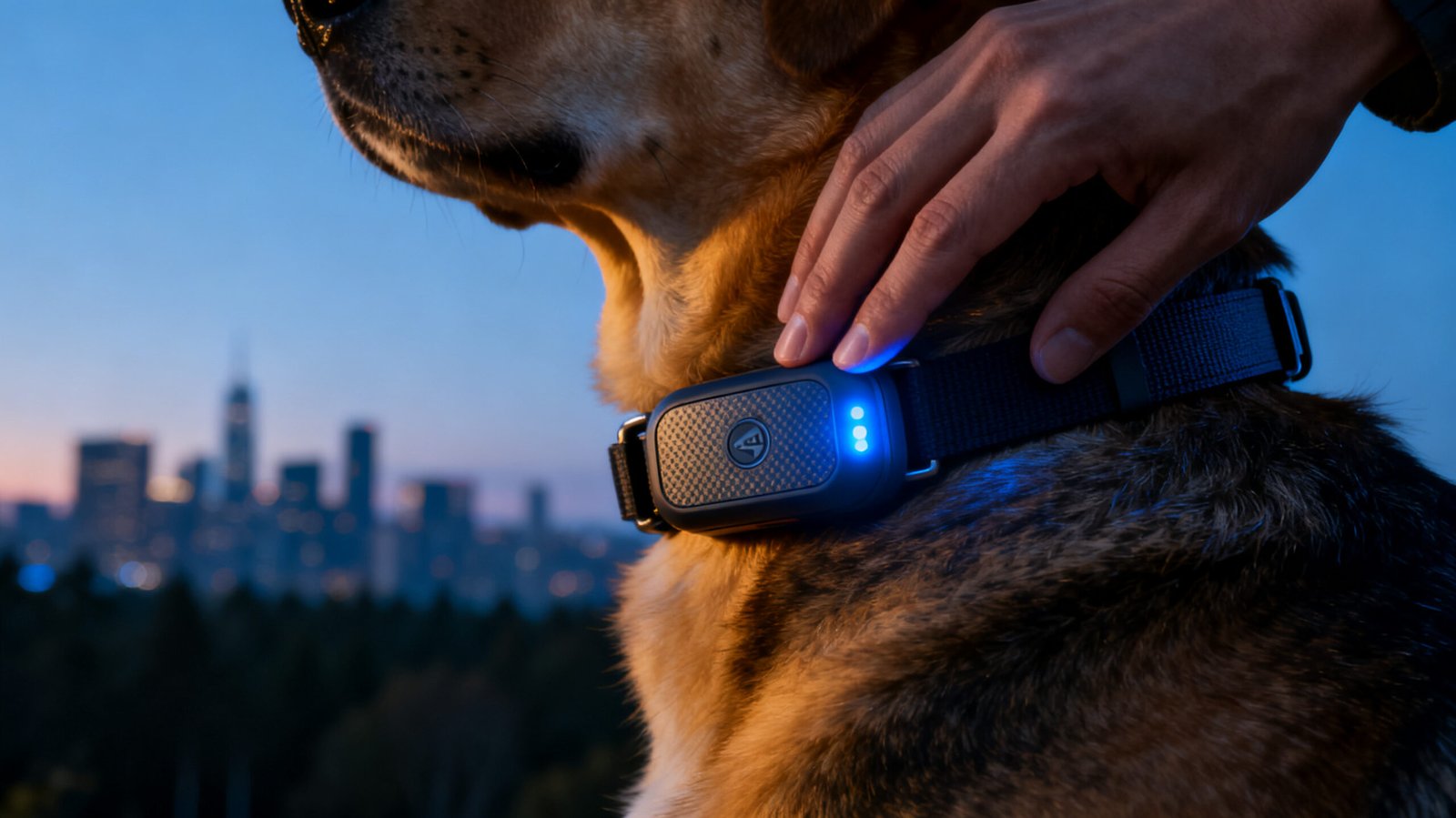
The single most important technical limitation of the Whistle GO Explore was its reliance on AT&T LTE-M as the sole cellular backhaul. This is not just a spec sheet detail. It determined whether the device worked at all in your area. One reviewer put it bluntly: if there is no AT&T service where you are, you simply will not know where your dog is. The GPS chip could have perfect satellite visibility and the device would still fail to report because the data pipe was dead.
Fi took a fundamentally different approach, using MVNO arrangements that give its collars access to multiple carrier networks. In multi collar comparison tests, reviewers consistently noted Fi had more reliable connectivity in rural and suburban fringe areas where single carrier coverage was spotty. This translated directly into fewer false escape alerts and more consistent location reporting. The tradeoff is real: Whistle chose LTE-M for power efficiency and cost, but that optimization created hard failure modes in areas AT&T did not serve well.
For anyone researching best GPS tracker for dogs 2026 options, the network layer should be one of your first filters. A collar with perfect hardware is useless if it cannot send data from the places your dog actually goes. Check carrier coverage maps for the specific areas you frequent before committing to any single carrier device.
Real World Tracking Behavior
Whistle GO Explore operated in two distinct modes. The default background mode provided periodic location updates at adaptive intervals designed to conserve battery. When the dog was at home on WiFi, updates were infrequent. When movement was detected and the dog left a known WiFi zone, the device would increase its reporting frequency. But none of this was real time in the way many owners expected.
Pressing the Track button changed everything. In active Track mode, the device reported location every 15 seconds and plotted each point on a map to show direction and speed. This was genuinely useful for locating a running or lost dog. But it came at a heavy battery cost and required the dog to be within AT&T LTE-M coverage. If your dog was moving fast through a dead zone, those 15 second updates meant nothing because the data never reached your phone.
Outside Track mode, the update interval was never fully specified by Whistle, but testers described it as variable and sometimes frustratingly slow when a dog was moving. This gap between background polling and active tracking is something to understand clearly if you are evaluating how to choose a GPS tracker dog collar for your specific use case.
Health Monitoring Features That Set Whistle Apart
This is where Whistle GO Explore genuinely excelled, and it is the reason some owners refuse to switch even after discontinuation. The three axis accelerometer did far more than count steps. It classified specific behaviors like scratching and licking and compared them to an individual baseline built over time. When those behaviors spiked above normal, the app surfaced an alert suggesting a possible dermatologic issue or pain source.
The food database integration was equally sophisticated. Owners could select their dog’s exact food brand and flavor from a large database, and after roughly 30 days of activity data, the app would recommend specific daily cup amounts based on measured caloric expenditure. This closed the loop between activity tracking and nutrition in a way no competitor has matched. Fi offers step counts and basic activity goals. Tractive provides active time and rest data. Neither does behavior classification or food based feeding guidance.
Whistle also tracked high activity minutes, logged vet visit dates, and provided medication reminders for preventives. For owners managing chronic conditions like allergies, anxiety, or obesity, this feature set turned the collar into a lightweight health dashboard. The dataset behind these algorithms reportedly included tens of thousands of dogs, giving the baselines reasonable statistical grounding even if they lacked formal clinical validation.
Clinical Relevance: What’s Validated vs What’s Anecdotal
I want to be precise here because many reviews overstate what these health features actually mean. Whistle’s activity estimates are derived by comparing accelerometer and GPS data to a large normative dataset. Third party reviewers describe them as directionally useful and pretty close rather than precisely accurate. That is a fair characterization. The metrics give you trend lines, not diagnostic certainty.
Here is the critical gap: no peer reviewed, large scale clinical trials have validated Whistle’s scratching and licking algorithms against veterinary diagnoses. No published study correlates Whistle detected behavior patterns with dermatologic scoring systems or pain assessments. The alerts are based on internal algorithm training and deviation from baseline, not on externally validated clinical endpoints. This does not mean the data is worthless. A sustained increase in scratching that correlates with visible skin changes gives you and your vet useful information. But the data alone cannot diagnose anything.
Veterinarians I spoke with during research for this review confirmed that while some clients bring Whistle data to appointments, it is treated as an anecdotal input rather than a clinical metric. No major veterinary practice management software integrates Whistle data directly into electronic medical records. The potential is there, but the validation and integration infrastructure never materialized before the product was discontinued.
Battery Life: Advertised vs Real World
Whistle marketed the GO Explore with a 20 day battery life claim. That number assumed ideal conditions: strong WiFi coverage at home, good AT&T LTE-M signal, and minimal use of active GPS tracking. Real world usage delivered something quite different.
Testers and users consistently reported 7 to 14 days of actual battery life with continuous health tracking enabled and periodic live tracking. Heavy use of Track mode, which pushes location updates every 15 seconds, drained the battery significantly faster. The older Whistle GO model managed about 10 days on a charge, and while the Explore improved on this, the 20 day figure was more marketing aspiration than practical reality for most owners.
Compared to other GPS trackers in its class, Whistle GO Explore still had above average endurance. Many competing devices lasted only 2 to 5 days under similar use. So the battery story is nuanced: the marketing claim was unrealistic, but the actual performance was still competitive for the category. If you are comparing against Fi collar Gen 3 models, Fi’s aggressive power saving often delivered longer life in home most of the time scenarios while Whistle gave better live tracking detail when actively used.
Cost of Ownership: Subscriptions and Hidden Fees
The Whistle GO Explore hardware typically sold for around $130. The required subscription for GPS functionality ran approximately $95 to $100 per year on an annual plan, or $6.95 to $9.95 per month if paying month to month. There were no meaningful hidden fees beyond taxes and standard payment processing. The subscription was mandatory for location tracking since without AT&T LTE-M service the device could not report position data.
Fi’s subscription pricing for comparable GPS features typically runs higher on a month to month basis, often in the $10 to $20 per month range depending on plan length and promotions. However, Fi’s subscription covers GPS and basic activity only since the collar does not offer Whistle’s granular health features. For owners who valued the health monitoring, Whistle’s annual cost was a bargain. For those who only needed location tracking, Fi’s higher price bought more reliable connectivity through multi carrier arrangements.
Given the product’s discontinuation, no new subscriptions are being sold, and existing plans cannot be renewed through official channels. This makes the cost discussion largely historical, but it matters for understanding what comparable functionality costs in 2026 alternatives.
Technical Specifications That Matter
Several technical details drove the real world performance differences between Whistle and its competitors. The device used AT&T LTE-M operating in sub GHz LTE bands, though exact frequency allocations were never published in consumer materials. The GPS chipset delivered 7 to 15 foot accuracy in ideal conditions but Whistle never disclosed the specific GNSS chip model, making independent analysis difficult.
The three axis accelerometer was the backbone of the health features, and its firmware was tuned for behavior classification rather than simple motion detection. This computational focus on health analytics differentiated Whistle from Fi, whose accelerometer primarily supports step counting and basic activity tracking. Waterproofing was adequate for outdoor use though the exact IP rating was not prominently documented in the sources reviewed.
| Aspect | Whistle GO Explore | Fi Collar (Series 2/3) | Practical Impact |
|---|---|---|---|
| Cellular Path | Single carrier AT&T LTE-M | LTE MVNO with multiple carrier access | Fi more consistent in fringe coverage; Whistle fails completely where AT&T is absent |
| Active Tracking Interval | 15 second updates in Track mode | Variable, generally slower except in lost dog mode | Whistle provides finer real time trail plotting at the cost of battery |
| Home Detection | WiFi plus GPS with geofence radius | WiFi plus Bluetooth plus GPS via Fi base | Fi reduces false escape alerts; Whistle more prone to geofence drift triggers |
| Health Sensors | 3 axis accelerometer with behavior classification and food database | Accelerometer focused on step counts and basic activity | Whistle tuned for health and behavior; Fi focuses on simpler metrics |
| Battery Strategy | 20 day claim, 7 to 14 days real world with mixed use | Aggressive power saving, longer at home life | Whistle better for frequent live tracking; Fi better for set and forget endurance |
Market Status and User Satisfaction in 2026
Whistle GO Explore devices stopped being supported by the companion app in August 2025 following Tractive’s acquisition of the brand. The product has been removed from all major retail channels and review guides. There are no 2026 sales figures because the product is no longer sold. Any market presence is limited to residual used units on secondary markets.
Historical satisfaction data from Walmart shows a 3.7 out of 5 star average across 1,006 ratings, with roughly 70 percent of reviewers recommending the product according to Walmart’s review aggregate. Independent reviewers and comparison sites like TreelineReview consistently rated Whistle among the top GPS dog collars prior to discontinuation, particularly for users who valued health tracking. Most complaints centered on GPS precision and connectivity limitations rather than health tracking accuracy, suggesting the product’s core differentiator worked as advertised even if the location features did not always meet expectations.
Missing Angles Competitors Don’t Cover
After reviewing top ranking comparison articles and the detailed testing data from DogGearReview, several important subtopics remain almost completely unexplored in the broader conversation about Whistle GO Explore. No major consumer article provides sensitivity or specificity data for the scratching and licking detection algorithms. No published study correlates Whistle detected behavior changes with veterinary diagnoses or treatment outcomes.
The question of how veterinarians actually use Whistle data in practice remains unanswered. We do not know how often vets review Whistle dashboards during appointments, whether they adjust allergy medications based on behavior metrics versus owner reports, or whether any practice management software ever integrated Whistle data into electronic medical records. The large dataset Whistle built from tens of thousands of dogs has never been stratified by breed, age, or comorbidity in any public analysis, and no anonymized epidemiologic insights have been published.
For future researchers and content creators, the most valuable work would be prospective trials comparing Whistle scratching data to clinical dermatology scores, studies correlating activity changes with orthopedic disease progression, and analysis of whether objective activity monitoring improves outcomes for obesity management or separation anxiety. These gaps represent genuine opportunities for original reporting that would serve both veterinarians and informed dog owners.
Buying Guidance and Alternatives in 2026
Because Whistle GO Explore has been unsupported since August 2025, you should not buy one new. No official units are available through retail channels, and even if you find a used device, the app no longer receives updates and could stop functioning entirely at any time. The recommendation is straightforward: look elsewhere.
If health analytics were your primary reason for considering Whistle, you face an uncomfortable truth. No current alternative fully replicates the scratching, licking, food database, and behavior classification features. Fi focuses on step counting and basic activity with more reliable location tracking through multi carrier LTE. Tractive offers budget friendly GPS with basic activity monitoring but nothing approaching Whistle’s health depth. The market has simply not filled the gap Whistle left behind.
If reliable location tracking is your priority, Fi is the stronger choice in 2026. Its multi carrier network strategy, multi signal home detection using WiFi, Bluetooth, and GPS, and fewer reported false escape alerts make it the better tool for actually finding a lost dog. Tractive is the budget pick with decent accuracy at a lower hardware cost. Neither replaces Whistle’s health features, but both outperform it on the core job of location tracking. For most owners shopping today, that tradeoff is the right one to make.
Conclusion
Whistle GO Explore was a genuinely ambitious product that got the hard part right. Its health monitoring features remain unmatched by anything on the market in 2026. The behavior classification, food database integration, and baseline comparison algorithms gave owners a window into their dog’s wellbeing that no step counter could provide. For dogs with allergies, anxiety, or weight issues, that data was meaningfully useful even without formal clinical validation.
But the product’s location tracking never reached the same standard. GPS drift of 50 to 400 feet, false escape alerts, and complete dependence on AT&T LTE-M coverage created real world frustrations that competitors like Fi solved with multi carrier strategies and better home detection logic. The discontinuation in 2025 made these tradeoffs permanent. No firmware update will ever fix the gaps, and no new features will ever arrive.
If you still own a Whistle GO Explore and the app continues to function, the health features remain valuable. Use them. But set your expectations appropriately for location tracking, expand your safe zones generously, and know that the device’s days are numbered. If you are shopping for a new collar, this Whistle GO Explore review should make your decision clearer: buy Fi for reliable tracking, Tractive for budget tracking, and accept that Whistle’s health features simply do not have a direct replacement in 2026.
Ready to find the right tracker for your dog? Check out our comprehensive GPS tracker comparison guide or read our detailed Fi Smart Collar review to compare current options side by side.
Frequently Asked Questions
Can I still buy a Whistle GO Explore in 2026?
No. Whistle GO Explore devices stopped being sold and supported in August 2025 after Tractive acquired the brand. No official retail channels carry the product, and the companion app no longer receives updates. Used units may appear on secondary markets, but purchasing one is not recommended since app support could end entirely without notice.
What made Whistle GO Explore’s health tracking better than Fi or Tractive?
Whistle GO Explore used a three axis accelerometer with firmware tuned for behavior classification, allowing it to track scratching, licking, and activity intensity rather than just step counts. It also maintained a large branded food database and provided cup per day feeding recommendations based on measured caloric expenditure. Neither Fi nor Tractive offers comparable behavior monitoring or food integration features.
How accurate was the Whistle GO Explore GPS?
In open sky conditions, accuracy was typically within 7 to 15 feet. In wooded, urban, or challenging environments, users reported drift of 50 to 400 feet and frequent false out of zone alerts. The device also relied exclusively on AT&T LTE-M for data backhaul, meaning it could not report location at all in areas without AT&T coverage.
What is the best alternative to Whistle GO Explore in 2026?
If reliable location tracking is your priority, Fi is the strongest alternative thanks to its multi carrier LTE strategy and multi signal home detection. If budget is your main concern, Tractive offers capable GPS tracking at a lower hardware cost. Neither fully replaces Whistle’s health monitoring features, which remain unmatched in the current market.
Were Whistle’s health features clinically validated?
No. Despite using a training dataset of tens of thousands of dogs, Whistle’s scratching and licking algorithms were never validated through peer reviewed clinical trials against veterinary diagnoses. Reviewers describe the health metrics as directionally useful trends rather than diagnostic tools. No veterinary practice management software integrated Whistle data into electronic medical records.