

### Blog Post:
If you have been searching “smart feeder vs gravity feeder” and feeling stuck between a cheap plastic bin and a $150 WiFi gadget, you are not alone. The pet tech market has exploded with promises of precision, convenience, and healthier cats. But the real question is simpler: does the upgrade actually solve the problem you have, or does it create three new ones you did not see coming?
This guide skips the marketing fluff and walks through what actually matters: portion control accuracy, real world maintenance headaches, hidden costs over time, and what veterinarians actually say when you ask them directly. By the end, you will know exactly which feeder type fits your cat, your budget, and your tolerance for troubleshooting.
Key Takeaways
- Gravity feeders cost under $25 and run forever without power but provide zero portion control, making them risky for any cat that tends to overeat.
- Smart feeders promise scheduled precision yet many measure in coarse units like 1/8 cup increments or vague “meal” counts, requiring manual calibration to get right.
- Owner reported regrets center on food jamming, cats breaking into the hopper, subscription paywalls, and battery failures that defeat the purpose of automation entirely.
- Quick answer: should you upgrade from a gravity feeder to a smart feeder?
- How gravity feeders and free feeding actually work (pros and cons)
- Top 3 real world complaints about gravity feeders
- What automatic and smart feeders promise and what they often miss
- Portion control accuracy: the critical issue comparison articles miss
- Health impact and obesity risk: what evidence exists and what is missing
- Cost and total cost of ownership considerations
- Unexpected owner regrets and maintenance failures with smart feeders
- Vet perspective: timed feeder vs portion control
- Decision checklist: which feeder is right for your cat
- How to get the best results if you choose a smart feeder
- If you stick with gravity feeding: harm minimizing tactics
- Conclusion and recommended next step
- Frequently Asked Questions
Quick answer: should you upgrade from a gravity feeder to a smart feeder?
If your cat is overweight, if you manage a multi cat household where one cat steals food, or if your veterinarian has prescribed scheduled meals, then upgrading to a smart feeder is clearly worth it. The ability to dispense measured portions at set times directly addresses the core failure of gravity feeding: unlimited access.
If your cat maintains a healthy weight on free feeding, shows no food anxiety, and you are on a strict budget, a gravity feeder may be perfectly adequate. The upgrade becomes optional, not urgent.
And if you are simply curious about pet tech but your cat is easygoing and trim, understand that you are buying a convenience gadget, not a health intervention. That is fine as long as you are honest about why you are buying it.
According to Petmate, gravity feeders “allow unlimited portions” and are not suitable for overweight cats. However, the supplied sources do not provide exact percentages comparing obesity rates between feeder types. Evidence is limited, so the decision rests on your specific cat and circumstances rather than a universal statistical argument.
How gravity feeders and free feeding actually work (pros and cons)
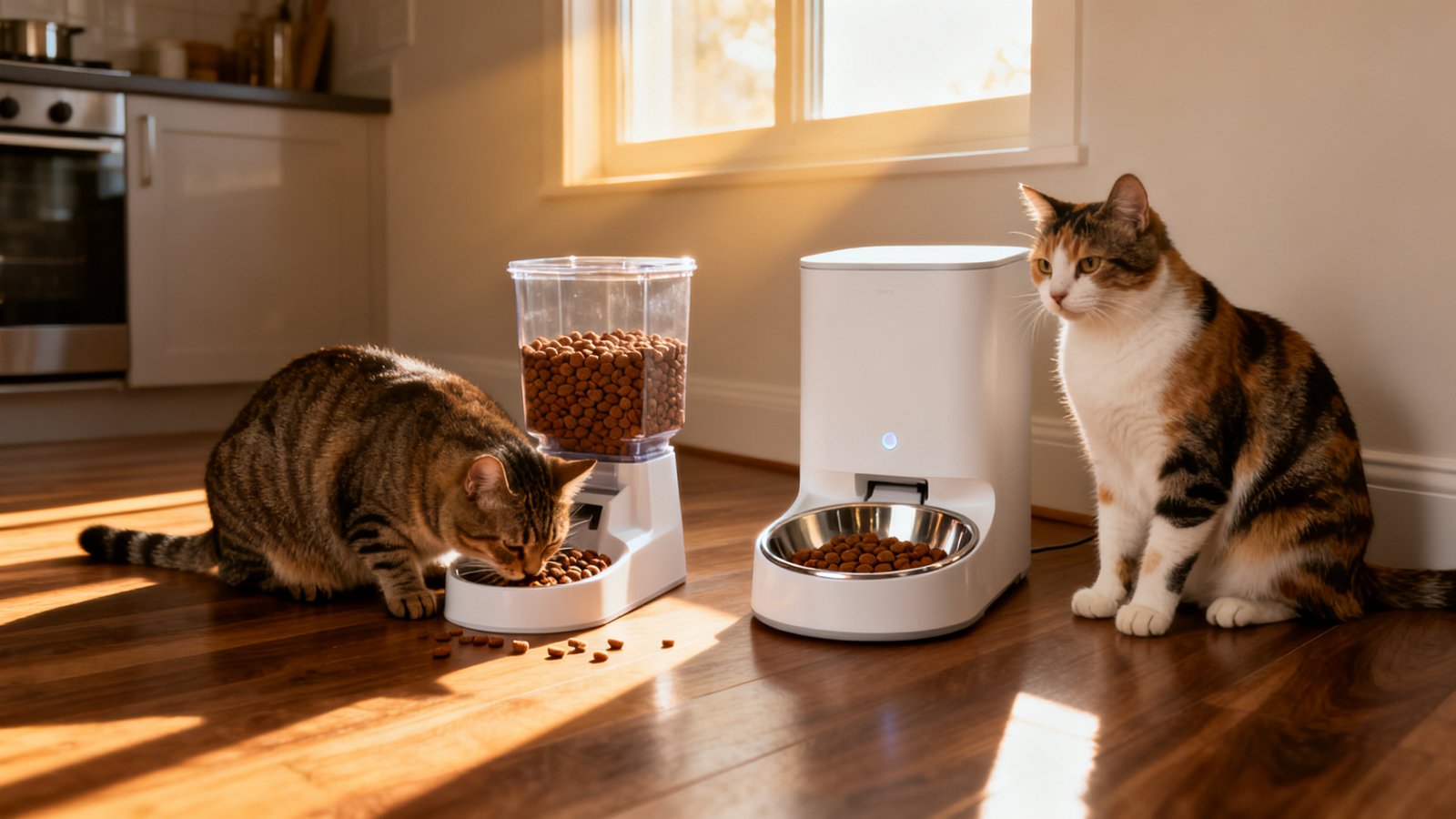
A gravity feeder is exactly what it sounds like. Dry kibble sits in a hopper above a bowl. As the cat eats, more food slides down to replace what was consumed. The mechanism is purely mechanical: no motors, no timers, no batteries, and no apps.
The pros are obvious. These feeders cost between $12 and $30. They never need charging. They never lose WiFi. They never require a firmware update at 11 PM when you are trying to sleep. For a busy household with a single cat that self regulates well, a gravity feeder can work for years with zero intervention beyond refilling the hopper and washing the bowl.
The cons are equally obvious once you think about them. Continuous access means the cat decides portion sizes, not you. A bored or anxious cat can eat far more than needed. And the design itself is vulnerable: a determined cat can knock the hopper over, paw food out of the dispensing gap, or simply camp at the bowl and graze all day.
TheCatSite notes that gravity feeders provide “unlimited, continuous access” to food. The same source states they are “not suitable for overweight cats.” But again, no precise calorie excess data is available in the research. The risk is logically clear even if the exact numbers are not published.
Top 3 real world complaints about gravity feeders
Reading through user reviews on Amazon and retailer sites reveals three recurring pain points that go beyond the obvious portion control limitation.
1. Food jams or gets trapped in the hopper. The Aspen Pet Lebistro feeder and Petmate Pet Café both generate consistent complaints about kibble bridging inside the hopper. Food appears full from the top but nothing reaches the bowl. Owners discover the problem only when the cat starts yowling at an empty dish. For a feeder designed to provide constant access, this failure mode is particularly ironic.
2. Cats hack or tip over the feeder. Some cats learn fast. They discover that bumping the hopper releases extra kibble. Others simply knock the entire unit over and feast on the spill. The Cats.com review notes gravity feeders are “some of the easiest for cats to hack or tip over.” If your cat is clever and food motivated, a gravity feeder becomes an all you can eat buffet with extra steps.
3. Lack of portion control leads directly to overeating. This is the complaint that ties everything together. Multiple sources confirm that gravity feeders give unlimited portions. For cats prone to weight gain, the feeder itself becomes a health liability. Owners who switch to portion controlled alternatives often report visible weight loss within weeks, though individual results vary widely.
What automatic and smart feeders promise and what they often miss
Smart feeders and automatic feeders sell themselves on four core promises: timed meals, precise portioning, remote control via app, and feeding activity monitoring. The best models let you schedule multiple meals per day, dispense specific amounts, and receive phone notifications when your cat eats.
The gap between promise and reality shows up in the details. Many smart feeders do not measure by weight. They measure in “meals” or “portions” that correspond to approximate volumes. The best automatic cat feeder 2026 models vary significantly in how precisely they dispense. Some use 1/8 cup increments, which works for larger cats but may be too coarse for a small cat on a strict calorie budget.
Other gaps include WiFi dependency. If your router goes down or the feeder loses connection, does it still dispense on schedule? Most do, but some app only models revert to manual mode. Subscription fees can also gate basic features like video history or extended activity logs. And mechanical reliability is not guaranteed: a feeder with a weak motor or poorly designed dispensing wheel will jam, especially with triangular or odd shaped kibble.
Portion control accuracy: the critical issue comparison articles miss
This is where most smart feeder vs gravity feeder comparisons fall short. They focus on feature lists: WiFi, app control, voice commands, camera integration. But the entire point of upgrading from a gravity feeder is controlling how much your cat eats. If the smart feeder cannot do that accurately, you paid extra for blinking lights and a notification that says your cat is hungry.
The PAPIFEED feeder measures by “number of meals” rather than by weight. Setting it to dispense two meals might give you roughly 20 grams, but the actual amount depends on kibble density, hopper fill level, and how the food settles. Owners report needing trial and error over several days to dial in the right amount. That is not precision. That is guesswork with extra steps.
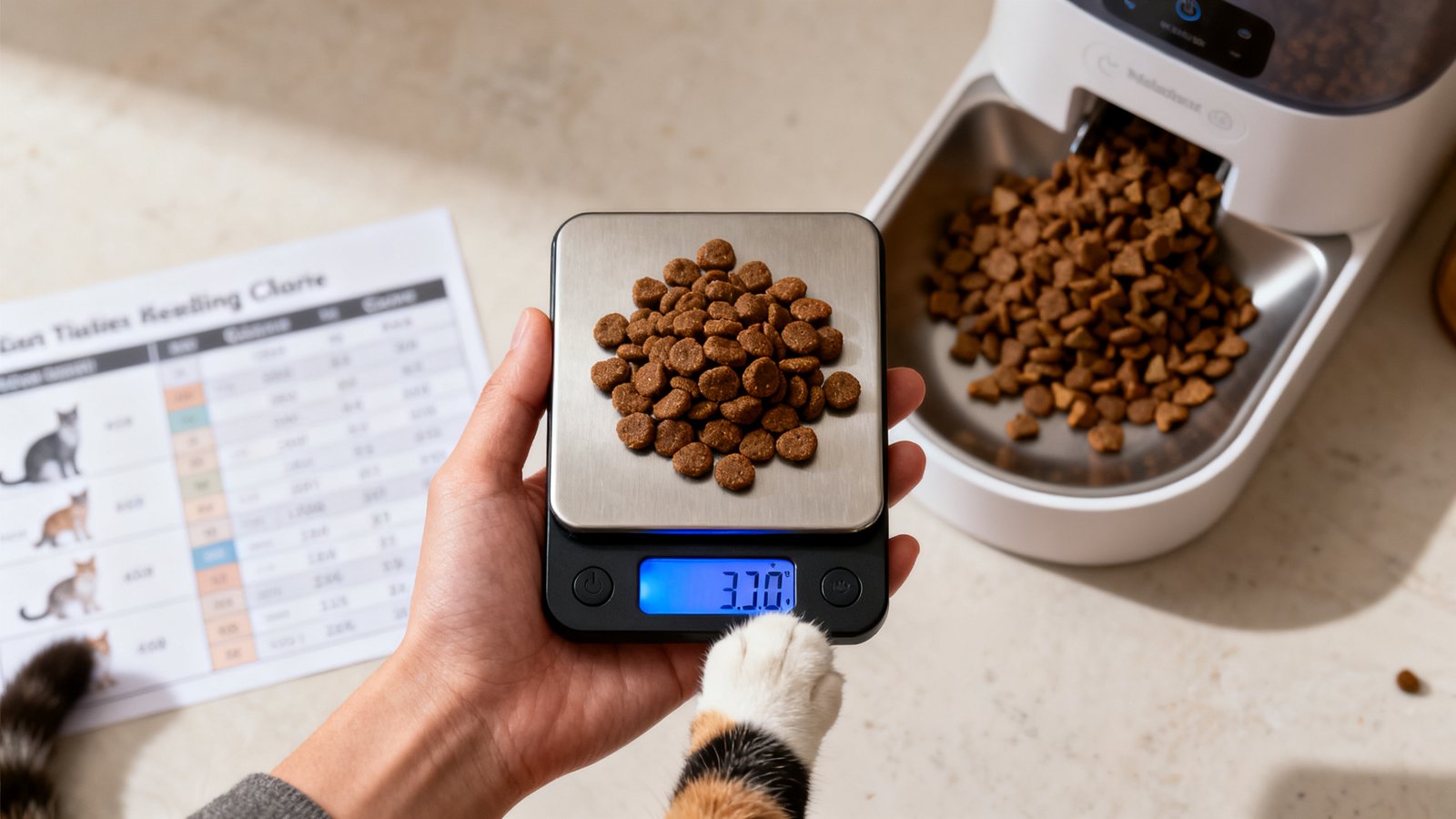
The PetSafe Smart Feed uses 1/8 cup increments. For reference, 1/8 cup of dry cat food typically weighs between 12 and 18 grams depending on the brand. If your veterinarian recommends 35 grams per meal, you are stuck choosing between roughly 24 to 36 grams (two increments) or 36 to 54 grams (three increments). That range can represent 15 to 20 extra calories per meal, which adds up fast for a sedentary indoor cat.
A gravity feeder, by contrast, offers no portion control at all. The comparison is not “precise vs imprecise” but rather “imprecise vs nonexistent.” For many cats, moving from zero control to coarse control is still a meaningful improvement. But if you need strict calorie management for a diabetic or severely overweight cat, coarse increments may not be sufficient. In those cases, you may need to combine the feeder with manual pre portioning or look for a model that measures by weight, not volume.
Health impact and obesity risk: what evidence exists and what is missing
Free feeding from a gravity feeder can cause cats to overeat and gain weight. That connection is logical and widely accepted. A cat with continuous access to food, especially a palatable dry kibble, will often consume more than its daily energy requirement.
What is missing from the available research is a direct percentage comparison. The supplied sources do not provide exact obesity rates for cats on gravity feeders versus smart feeders. No study in the reviewed material states “X percent of gravity fed cats become obese compared to Y percent of portion controlled cats.” The evidence is limited to the mechanistic observation that unlimited access enables overconsumption.
This does not mean the concern is invalid. It means the argument for upgrading rests on logic and individual veterinary guidance rather than a cited statistic. If your cat is already overweight, the absence of a neat percentage does not change the practical reality: switching to measured, scheduled meals is a sensible intervention. If you want data driven insights into your pet’s overall wellness, a best pet health monitor 2026 can complement a feeding strategy by tracking activity patterns that correlate with weight changes.
Cost and total cost of ownership considerations
Upfront cost is the easiest number to compare. A basic gravity feeder runs $12 to $30. A competent smart feeder starts around $60 and climbs past $150 for models with cameras, app control, and multi pet recognition.
But the real comparison lives in total cost over time. The supplied sources do not calculate a specific 5 year figure, so here is a framework to build your own estimate:
| Cost Factor | Gravity Feeder | Smart Feeder |
|---|---|---|
| Upfront purchase | $12 to $30 | $60 to $180 |
| Power costs | None | Batteries or minimal electricity, roughly $5 to $15 per year |
| Subscription fees | None | $0 to $60 per year depending on brand |
| Replacement parts | Rarely needed | Desiccant bags, dispensing wheels, bowls: $10 to $30 per year |
| 5 year estimated range | $12 to $35 | $85 to $630 |
The wide smart feeder range depends heavily on whether the brand charges a subscription. The PETKIT Yumshare+ requires a subscription for cloud recordings beyond 30 seconds. Some smart dog feeder with camera models bundle features behind paywalls too. If you refuse all subscriptions, your 5 year cost stays near the low end. If you subscribe to full features, the total climbs fast.
For budget conscious cat owners exploring cheaper options, pet tech gadgets under 50 exist, but be realistic about what a sub $50 smart feeder can deliver. At that price point, you are often trading precision and reliability for the low entry cost.
Unexpected owner regrets and maintenance failures with smart feeders
Smart feeder owners report several consistent frustrations that rarely make it into the marketing copy.
Jamming and clogging. The Petlibro Granary WiFi feeder generates complaints about clogging, sometimes from day one. One Cats.com commenter reported: “It started clogging… I then bought the Petlibro Granary WiFi feeder and it has been clogging up from the beginning.” A feeder that clogs is worse than a gravity feeder because you may not notice for hours, assuming the machine is working while your cat goes hungry.
Cats breaking into the hopper. The Cat Mate C200 and C500 are specifically noted as vulnerable. A persistent cat can work the lid open or paw kibble through the dispensing slot. If your cat treats feeder hacking as a puzzle game, a smart feeder may not outsmart them for long.
Power and battery failures. The Cat Mate C3000 receives low ratings for reliability. Owners report units breaking down quickly or failing to dispense consistently. A feeder that loses power silently becomes an obstacle between your cat and its next meal.
Measurement inaccuracies requiring resets. The PAPIFEED feeder displayed incorrect meal counts after initial setup, forcing owners to reset and reconfigure. If you are away from home relying on the feeder, a glitch like this can go undetected until you return.
Subscription feature gates. Some feeders lock basic functionality behind a subscription. Video history, extended alert logs, and even portion adjustment may require a monthly fee. Owners who missed this detail during purchase express frustration when features stop working after a trial period ends.
Vet perspective: timed feeder vs portion control
The supplied sources do not present a formal veterinary consensus on whether timed feeding alone suffices or whether strict portion control is always necessary. What they do agree on is straightforward: consult your veterinarian before relying solely on a gravity feeder, especially if your cat is overweight.
The Petmate article advises owners to “carefully consider their cat’s needs and consult a veterinarian.” TheCatSite notes that overweight cats “may benefit from portion control” using an automatic feeder.
In practical terms, veterinarians typically care about total daily calorie intake and meal frequency. A timed feeder that dispenses two or three scheduled meals per day addresses the meal frequency side. Whether it addresses the calorie side depends entirely on how accurately you can set those portions. If your vet prescribes 200 calories per day split into three meals, and your feeder dispenses in increments that make hitting 200 exactly impossible, you still have a math problem.
For cats with diagnosed conditions like diabetes, where meal timing and precise calorie intake are both critical, a feeder that measures by weight is strongly preferred. For a generally healthy cat that simply needs to stop grazing, a timed feeder with coarse portion control may be perfectly adequate. The distinction matters and your vet can help you decide which camp your cat falls into.
Decision checklist: which feeder is right for your cat
Use this checklist to make a clear choice rather than going in circles. Answer each question honestly.
- Is your cat currently overweight or has your vet recommended weight loss? If yes, upgrade to a smart feeder with portion control. If no, continue.
- Do you have more than one cat and need to prevent food stealing? If yes, a smart feeder with multi cat recognition or separate scheduled bowls is the better path. If no, continue.
- Are you away from home for long stretches and need automated scheduled meals? If yes, a smart feeder solves a real logistical problem. If you are home for most meals, gravity feeding with manual portion control may work.
- Is your cat a food hacker that knocks over feeders or paws food out? If yes, a sturdy gravity feeder might actually be more resilient than a smart feeder with mechanical weak points. Or you may need a heavy, tip resistant smart model.
- Is your monthly budget tight and subscription fees a non starter? If yes, stick with a gravity feeder and implement manual portion control strategies. A smart feeder with surprise subscription costs will only create financial stress.
- Do you have the patience to calibrate, test, and monitor a smart feeder for the first two weeks? If yes, proceed with a smart feeder purchase. If you want a set it and forget it solution, understand that no smart feeder is truly maintenance free.
How to get the best results if you choose a smart feeder
If you decide to upgrade, these steps will prevent the most common first month regrets.
Test measure portions by weight before relying on the feeder. Using a digital kitchen scale, dispense ten portions and record each weight. Calculate the average and standard deviation. If the variation exceeds 10 percent, factor that into your daily calorie calculations or consider a different model.
Calibrate the feeder with your specific kibble. Kibble shape and density affect dispensing. Triangular kibble jams more often in rotary dispensers. Small round kibble can slip through in larger quantities. Run your calibration test with the exact food you intend to use long term.
Monitor the first two weeks closely. Watch for jams, check that meals dispense on time, and observe whether your cat tries to break into the hopper. If you have a monitor pet while at work setup, use it to verify midday dispensing during the trial period.
Plan for power outages. If your smart feeder uses batteries as backup, confirm that the backup actually works by unplugging the unit and testing a scheduled meal. If it relies solely on wall power, consider a small UPS or accept the risk that a power outage means manual feeding.
Review subscription terms before purchasing. Read the fine print on what features require a monthly fee. If video history or extended logs matter to you, factor that recurring cost into your decision. Some buyers discover the paywall only after the trial expires and features disappear.
If you stick with gravity feeding: harm minimizing tactics
Staying with a gravity feeder does not mean giving up on portion control entirely. You can implement several strategies to reduce the risks of free feeding without buying a smart device.
Switch to measured bowl servings. Instead of filling the hopper, measure your cat’s daily portion into a separate container each morning and pour only that amount into the feeder. When the food is gone, it is gone. This preserves the gravity mechanism while enforcing a daily calorie cap.
Set timed meal times manually. If your schedule allows, put the food down at specific times and remove it after 20 to 30 minutes. This mimics the scheduling benefit of a smart feeder without any technology. It requires you to be present, which is the tradeoff.
Weigh portions with a kitchen scale. Do not rely on measuring cups. Dry kibble settles and cup measurements can vary by 15 percent or more depending on how you scoop. A scale removes that variable.
Consult your veterinarian for portion size recommendations. The calorie needs of a 10 pound sedentary indoor cat differ significantly from a 14 pound active cat. Your vet can provide a target daily calorie number, and you can work backward from the kibble packaging to determine grams per day. This step alone often reveals that the cat has been eating 20 to 30 percent more than needed from an always full gravity hopper.
Conclusion and recommended next step
The smart feeder vs gravity feeder decision comes down to one question: does your cat need portion control that you cannot reliably deliver manually? If yes, a smart feeder is worth the investment, the calibration effort, and the ongoing maintenance. Choose a model with the finest portion increments you can afford, test it rigorously during the return window, and do not pay for subscriptions you will not use.
If your cat is healthy, self regulates well, and you are present for meals, a gravity feeder paired with manual portion control tactics costs almost nothing and avoids the maintenance headaches that smart feeder owners frequently report. The key is committing to measured portions and scheduled meal times, even if the feeder itself is a simple hopper.
Your next step: weigh your cat this week. Schedule a vet visit if you have not had one in the past year. Get a target daily calorie number. Then decide whether your current feeding method can hit that target consistently. If it cannot, you know what to do. If you are exploring other pet tech to round out your setup, a best pet camera 2026 can give you visual confirmation that meals are happening on schedule when you are not home.
Frequently Asked Questions
Is a smart feeder worth it for cats that only eat dry food?
It depends on the cat’s weight and eating behavior. For an overweight dry food cat, a smart feeder provides portion control that gravity feeding cannot. For a healthy weight cat that grazes moderately, the upgrade may be unnecessary. The value comes from solving a specific problem, not from the technology itself.
Can I use a gravity feeder and still control my cat’s portions?
Yes, by measuring the daily food amount into the hopper each morning instead of filling it completely. Once the measured portion is consumed, the cat cannot overeat until you refill it. This hybrid method gives you portion control without buying new equipment.
Do all smart feeders require a subscription?
No. Many models function fully without a subscription, dispensing scheduled meals and tracking basic activity. Subscriptions typically unlock cloud video storage, extended history, or advanced alert features. Check the specific model’s feature list carefully before buying to avoid surprises.
What is the most common reason smart feeders fail?
Food jamming is the most frequently reported failure. Kibble shape, hopper design, and motor strength all contribute. Triangular or large kibble is more likely to bridge inside the hopper or jam the dispensing wheel. Testing with your specific food during the return window is essential.
Should I get a timed feeder or a gravity feeder for a multi cat household?
A timed feeder is almost always the better choice for multi cat homes because it prevents one cat from monopolizing the food. Gravity feeders in multi cat settings typically result in the dominant cat overeating and the timid cat undereating. Some smart feeders even offer multi cat recognition to further separate portions.