

Finding the best automatic cat feeder 2026 is not about scrolling through a list of features you will never use. It is about matching a machine to your actual household rhythm: how many cats you have, how precise the portions need to be, whether your WiFi drops at 3 a.m., and if you are willing to pay a subscription just to see your cat eat. This guide skips the marketing fluff and focuses on what breaks, what costs extra, and what actually works after six months of daily use.
Key Takeaways
- Top overall pick: PETLIBRO Granary leads for portion precision (1/20 cup or roughly 6 g increments) and WiFi reliability when set up on a dedicated 2.4GHz band, though exact gram weights vary by kibble density and you should verify with the manufacturer.
- WiFi is the number one failure point: Three of the top Amazon complaints across all smart feeders involve connectivity drops, difficult initial pairing, and forced re-pairing after firmware updates. Dual-band support is not universal, appearing in only 25% to 75% of WiFi models depending on which buying guide you trust.
- Hidden subscriptions are real: Several camera equipped feeders lock cloud recording behind monthly fees. If you want video history without paying forever, choose a model with local storage or subscription free cloud access.
- Quick TL;DR — Best automatic cat feeder 2026
- Buying criteria that actually matter
- Precise scheduling and portion control
- Connectivity and app reliability
- Hidden costs and subscription traps
- Multi-cat feeding and selective access
- Portability and power backup
- App feature wishlist
- Which popular reviews miss critical buyer needs
- Best picks by household scenario
- Short buying checklist and in-store test protocol
- FAQ
Quick TL;DR — Best automatic cat feeder 2026 (Top pick + 2 runners up)
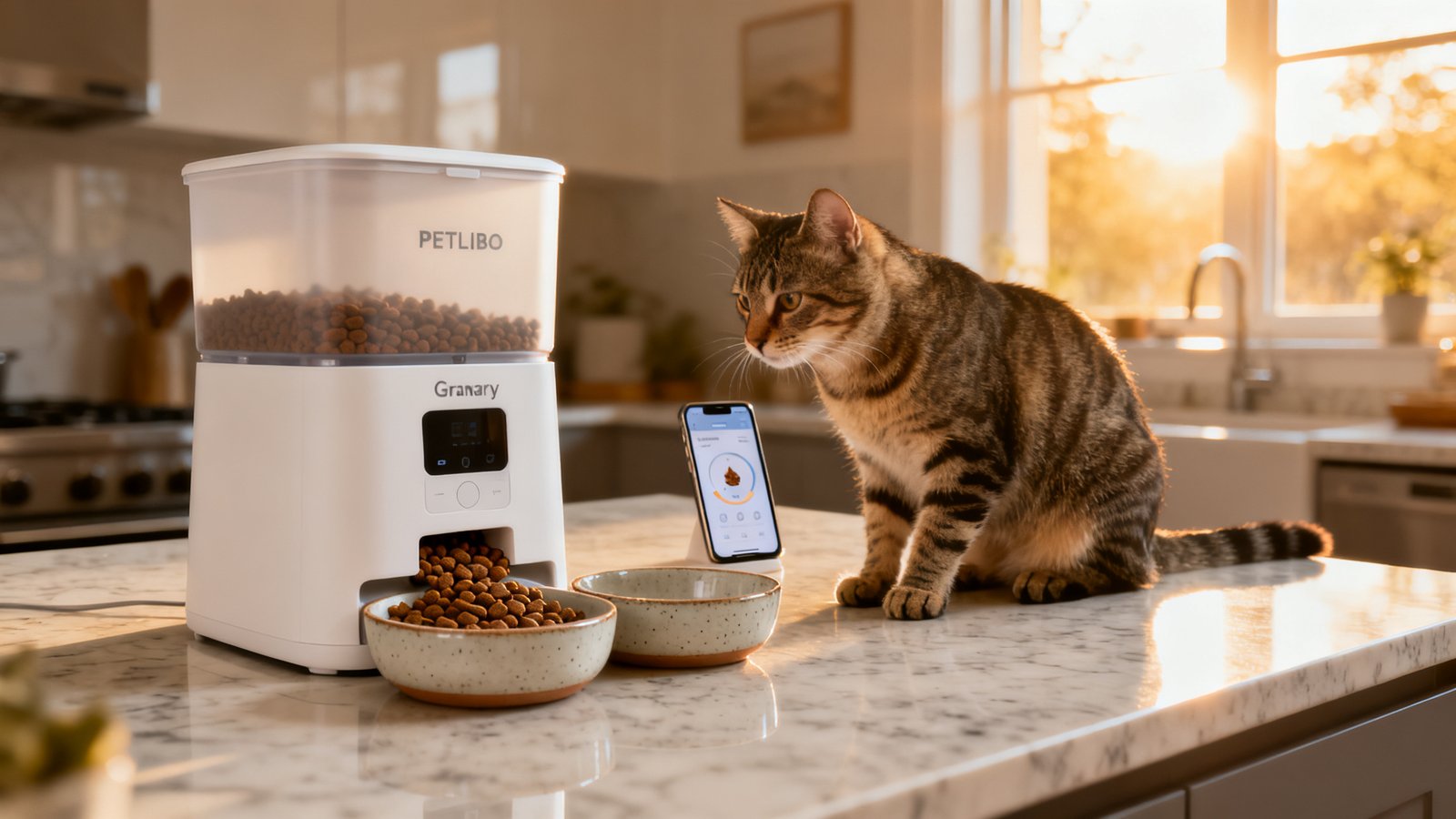
If you need an immediate answer without reading the full breakdown, here it is. The best overall WiFi cat feeder in 2026 is the PETLIBRO Granary for single cat homes that demand granular portioning. It handles up to 10 meals per day with 1 to 48 portions per meal, where each portion is roughly 1/20 cup, approximately 6 grams depending on kibble shape and density. The app scheduling is straightforward once connected, and the hopper seals well against humidity.
For multi-cat households, the best WiFi cat feeder 2026 option with true dual bowl functionality is the oneisall 5G WiFi model, which dispenses roughly 10 g per portion (1/12 cup) and includes a splitter for two bowls. If you need a camera without committing to a monthly cloud bill, consider the Frienhund 2K Camera feeder which supports up to 15 meals per day and up to 20 portions, but be aware that cloud storage features may require a paid subscription after a trial period. For a reliable budget WiFi model, the VOLUAS delivers 1 to 4 meals per day with portions from 0 to 40, each approximately 7.5 g, on a simple app that rarely disconnects.
What to check before you click buy: Confirm the exact gram weight per portion for your specific kibble by calling the manufacturer or testing with a kitchen scale during the return window. Published portion weights assume average kibble density and yours may differ.
Buying criteria that actually matter (what to test before you buy)
Most buying guides list features. This one lists failure points. When shopping for an automatic cat feeder programmable enough to handle your schedule, five criteria separate the machines that last three years from the ones that end up in a closet after three weeks.
App reliability and WiFi band compatibility is the single biggest differentiator. A feeder with a fantastic motor but a broken app is just an expensive plastic bin. Look for dual band support (2.4GHz and 5GHz) because many modern routers merge both bands under one SSID and single band feeders often fail to connect in those environments. The top three Amazon complaints across all WiFi feeder brands are difficult or inconsistent WiFi setup, connectivity drops that skip meals, and the app requiring full re-pairing after firmware updates.
Portion granularity in grams matters if your cat is on a calorie controlled diet. A feeder that only adjusts in 1/4 cup increments is useless for a cat that needs exactly 32 grams of kibble per meal. The best smart cat feeder portion control systems offer increments of 6 to 10 grams, letting you dial in precise calorie doses without guesswork.
True multi-cat support means more than just a splitter accessory. RFID or microchip identification like the SureFeed system is the gold standard, though it is absent from most WiFi feeder buying guides. At minimum, look for dual bowl dispensing with independent scheduling so each cat gets the right amount without food theft.
Battery backup and portability protect your feeding schedule during power outages and travel. Only the PetSafe Smart Feed includes a built-in battery backup in the reviewed sources. Most other WiFi feeders require an external USB battery bank, which you must purchase separately and remember to keep charged.
Subscription friction is the hidden dealbreaker. Some camera equipped feeders offer basic live streaming for free but lock cloud recording, smart alerts, or video history behind monthly plans costing $4 to $10 per month. Read the fine print before you buy.
Precise scheduling and portion control — the numbers shoppers want
A timed cat feeder automatic enough to replace you needs exact scheduling parameters. Here is what the top 2026 models actually deliver in terms of meals per day and portion weights, so you can match the specs to your cat’s prescribed calorie dosing.
The PETLIBRO Granary leads with up to 10 meals per day and 1 to 48 portions per meal. Each portion is advertised as 1/20 cup, roughly 6 grams, though independent testing shows this can vary from 5 to 8 grams depending on kibble shape and density. One source reports a model variant conflict where portion weights differ between firmware versions, so confirm directly with PETLIBRO support before relying on a specific gram number for medical dosing.
The VOLUAS offers 1 to 4 meals per day with portions ranging from 0 to 40, where each portion dispenses approximately 7.5 grams. This is a simpler scheduler but the larger portion increment makes it less suitable for cats needing ultra precise micro-dosing.
The oneisall 5G WiFi model uses a 1/12 cup portion size, approximately 10 grams per portion. The ANDOLL HOME feeder supports up to 8 meals per day with flexible portioning. The Frienhund 2K Camera feeder tops out at 15 meals per day with up to 20 portions per meal, giving you the most scheduling slots of any WiFi feeder reviewed.
What to check before you click buy: Weigh the first 10 dispensed portions on a kitchen scale during the first week. Take the average and use that number for calorie calculations, not the advertised spec.
Connectivity and app reliability — what breaks in real homes
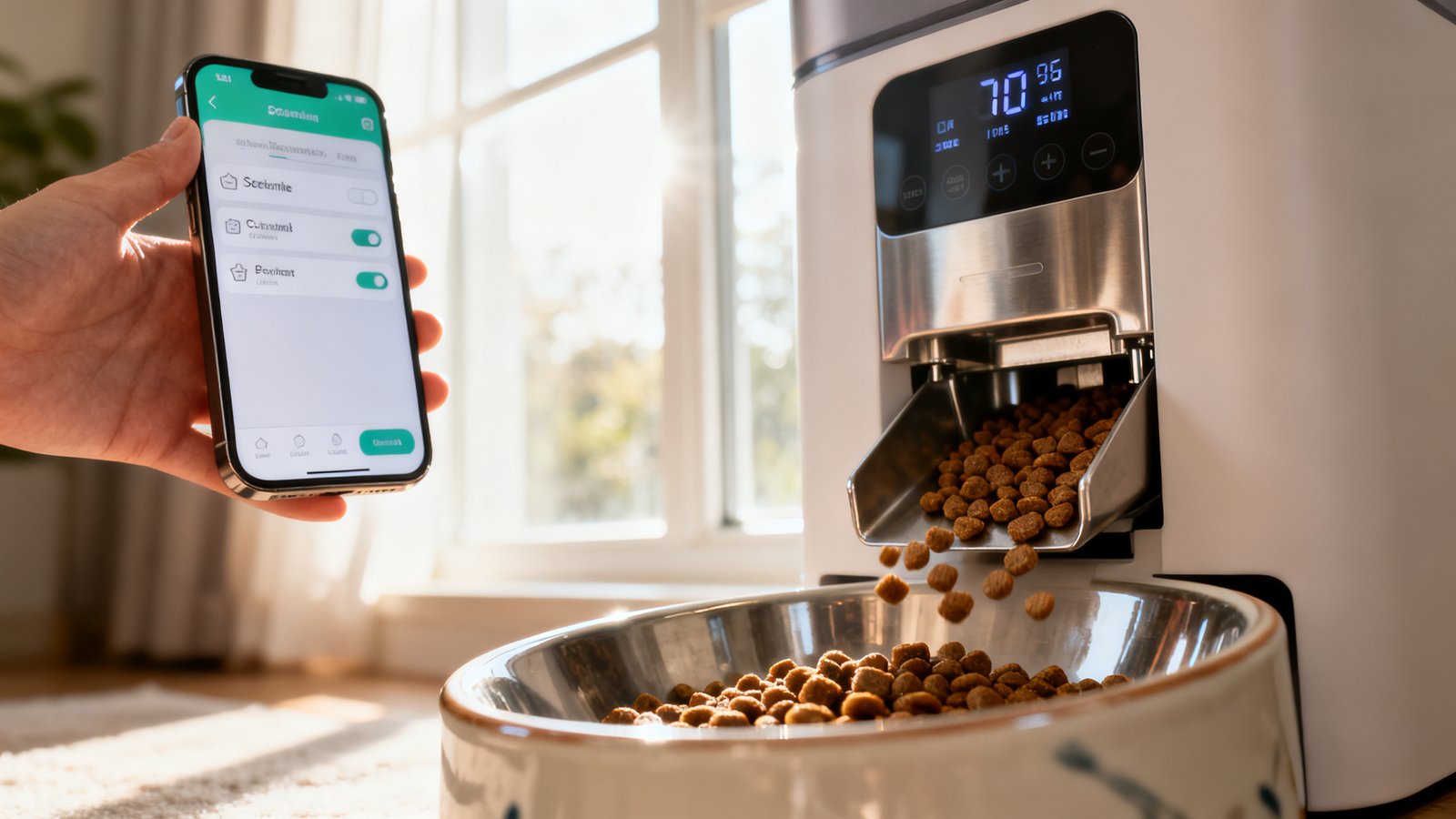
A smart cat feeder WiFi app that drops connection is worse than a dumb feeder with a mechanical timer. At least the mechanical timer still works when your router reboots. Understanding the common failure modes saves you from buying a feeder that works perfectly in the demo video and terribly in your living room.
The most frequent connectivity complaint across all WiFi feeder brands is the initial setup process. Many 2.4GHz only feeders cannot connect to modern dual band routers that merge both frequencies under one network name. The workaround is to temporarily separate your bands, connect the feeder, then re-merge them, but this is not something the average cat owner should have to figure out. Among reviewed product lists, IZreview found 3 out of 4 WiFi models (75%) supported dual band, while theconsumers.guide reported only 1 out of 4 WiFi models (25%) as dual band, highlighting that no consistent industry standard exists.
The second major pain point is forced re-pairing after firmware updates. Some feeders automatically update overnight and wake up disconnected, requiring you to go through the full setup process again. If you are traveling and this happens, your cat misses meals until you return home to physically press the pairing button. Before buying, search the product’s Amazon reviews for the phrase “firmware update” and read the most recent complaints.
The best WiFi cat feeder 2026 models handle WiFi recovery gracefully. They store the feeding schedule on the device itself, so even if WiFi drops, the next meal dispenses on time. They reconnect automatically without human intervention. And they send a push notification when they go offline, rather than silently failing.
| Model | Dual Band WiFi | Local Schedule Storage | Auto Reconnect | Re-pairing Complaints |
|---|---|---|---|---|
| PETLIBRO Granary | Varies by variant | Yes | Generally yes | Moderate |
| VOLUAS | No (2.4GHz only) | Yes | Yes, reliable | Low |
| oneisall 5G WiFi | Yes (5G support) | Yes | Yes | Low to moderate |
| Frienhund 2K Camera | No (2.4GHz only) | Yes | Mixed reports | Moderate to high |
Hidden costs and subscription traps
Some smart cat feeder WiFi app experiences start free and then surprise you with paywalls. The most common trap is cloud video storage for camera equipped feeders. The Frienhund 2K Camera feeder, for example, offers live streaming for free but locks cloud recording and smart motion alerts behind a subscription that multiple reviewers flag as a significant friction point. Before choosing a camera feeder, decide whether live viewing is enough or if you need recorded history. If you need recordings, factor the subscription into the total cost of ownership.
Beyond camera subscriptions, watch for feeders that gate advanced scheduling features, multi user access, or Alexa integration behind premium tiers. The best automatic cat feeder 2026 models keep core feeding functions completely free and only charge for optional cloud services. If a feeder requires a subscription just to set more than 4 meals per day, skip it. That is a core function, not a premium feature.
If you are considering a camera equipped pet feeder, also explore standalone options. Our best pet camera 2026 guide covers models that may pair better with a non-camera feeder, and the Furbo 360 camera review explains why treat tossing cameras are a different category entirely.
What to check before you click buy: Open the app store listing for the feeder’s companion app and sort reviews by most recent. Look for complaints about features that were free and suddenly became paid. This pattern indicates a company testing monetization strategies on existing users.
Multi-cat feeding and selective access — solutions that matter
An automatic cat feeder programmable for a single cat is straightforward. Adding a second cat introduces food theft, portion confusion, and the challenge of feeding different diets. The market offers three approaches, and only one truly solves the multi-cat problem.
The gold standard is RFID or microchip selective access, currently best executed by the SureFeed microchip feeder. It reads your cat’s existing microchip or a collar tag and only opens the lid for the authorized cat. The downside is that SureFeed is not a WiFi connected feeder and rarely appears in smart feeder buying guides. It is worth considering as a companion to a WiFi feeder for the cat that needs protected, separate meals.
The middle ground is dual bowl WiFi feeders with independent scheduling. The oneisall dual bowl model and WOPET’s dual scheduling feeder dispense to two bowls on separate timers. This works if your cats respect bowl boundaries, but a determined food thief will simply push the other cat aside. The PalNests splitter takes this further by adding a physical divider and dual chute system.
The third approach, using two separate WiFi feeders, is the most expensive but also the most reliable for cats that refuse to share space during meals. Place feeders in different rooms and schedule them simultaneously so each cat is occupied with their own food.
What to check before you click buy: If you choose a dual bowl feeder, verify that portion sizes are independently adjustable per bowl. Some dual bowl models split the same portion between both bowls, which defeats the purpose for cats with different dietary needs.
Portability and power backup — buying for travel and outages
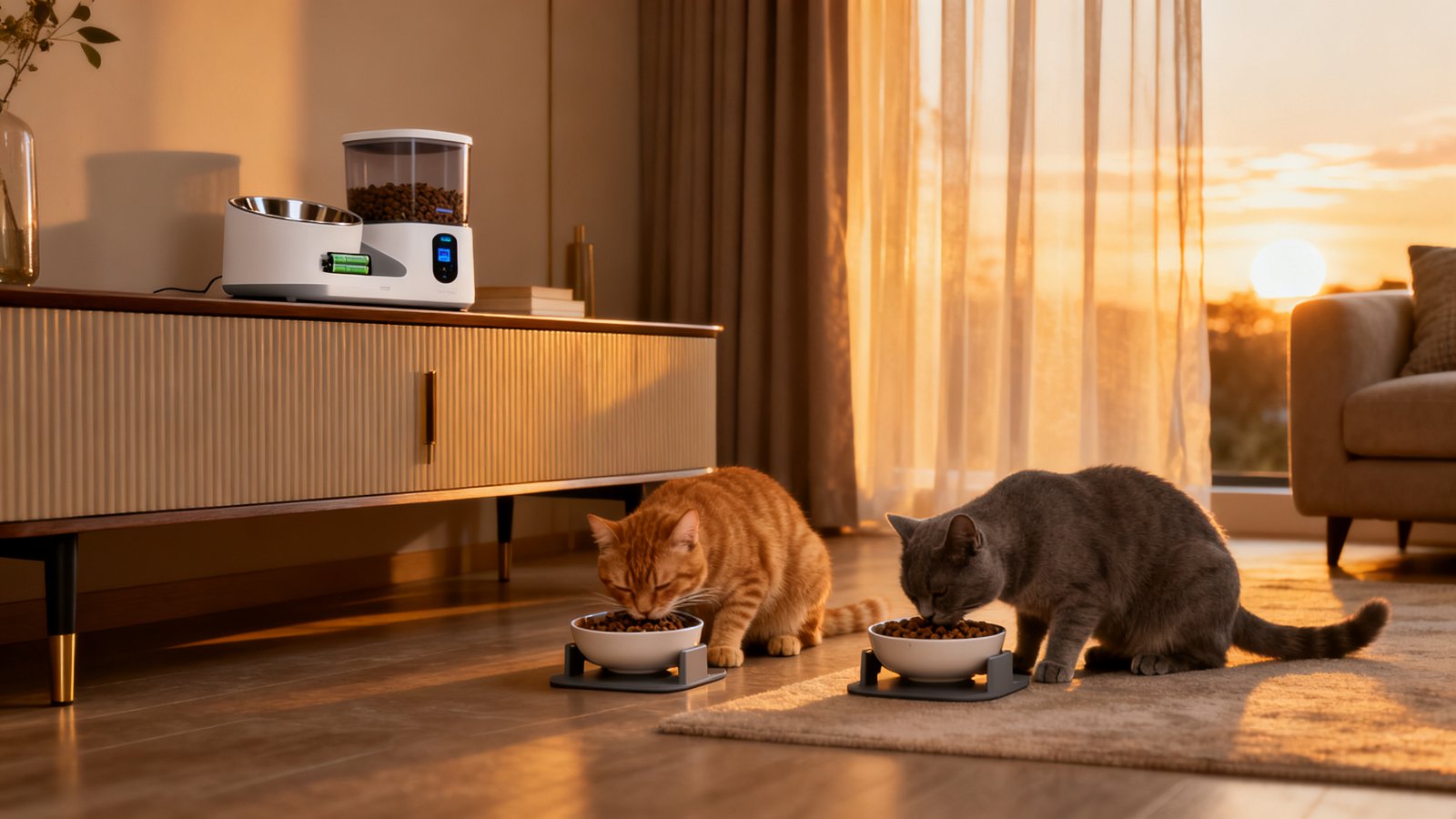
A timed cat feeder automatic enough to trust during a weekend trip needs to survive a power outage. Most WiFi feeders have no built-in battery. They rely entirely on wall power, and when the power goes out, so does your cat’s dinner schedule. Among all reviewed sources, only the PetSafe Smart Feed includes a built-in battery backup as a standard feature. Every other WiFi feeder requires an external USB battery bank, which you must purchase separately and test regularly.
For true portability, gravity feeders and non-WiFi battery operated dispensers are more reliable than smart feeders. A pet camera treat dispenser combined with a basic timed feeder can give you remote interaction without risking a WiFi failure during a critical meal. If you travel frequently, pack a basic battery powered backup feeder even if your primary unit is a smart WiFi model.
What to check before you click buy: Look at the power input spec on the feeder. If it uses a standard USB connection (micro USB or USB C), you can power it from any battery bank. If it uses a proprietary barrel jack, you are locked into the manufacturer’s ecosystem and finding a backup power solution becomes much harder.
App feature wishlist — what top lists miss and readers should demand
Most “best of” articles list the same features: scheduling, portion control, and maybe a camera. But the smart cat feeder WiFi app ecosystem is missing capabilities that would meaningfully improve cat health and owner peace of mind. Here is what you should demand from manufacturers.
Dual chamber mixing with custom ratios is a standout feature on the PalNests system that lets you blend two kibble types in the same meal, useful for cats transitioning diets or needing a mix of dental and regular food. Microchip or RFID pet identification as seen on SureFeed should be standard on WiFi feeders for multi-cat homes. Integrated battery backup should not be a premium add on, it should be included in every feeder over $80.
Health and weight tracking integration is the biggest missed opportunity. No mainstream WiFi feeder syncs with a smart scale or pet health app to adjust portions automatically based on weight trends. Subscription free cloud recording for camera models should be the default, with local SD card storage as a fallback. If a $35 Eufy pet camera can offer local storage without a subscription, a $150 feeder should too.
What to check before you click buy: Download the feeder’s app before purchasing the hardware. Create an account and explore the settings menu. If advanced features are locked behind a “premium” badge before you even own the device, that tells you everything about the company’s monetization priorities.
Which popular reviews miss critical buyer needs (multi-cat, portability, or app reliability)
Not all buying guides are created equal, and some omit the very criteria that determine whether a best automatic cat feeder 2026 pick actually works in your home. The “Top 10 Pet Feeder Manufacturers Leading the Market in 2026” published by vekenindustry.com does not discuss multi-cat feeding or portability at all. It reads like a manufacturer directory, not a buyer’s guide, and should not be relied upon for purchasing decisions.
In contrast, IZreview and theconsumers.guide do address multi-cat scenarios where relevant, though their dual band WiFi reporting conflicts significantly, as noted earlier. When reading any review, check whether the author has actually lived with the feeder for more than a week. Short term testing catches obvious defects but misses the slow burn issues like app disconnections after firmware updates or portion drift as the motor ages.
The broader pet tech review landscape has similar gaps. As noted in comprehensive gear reviews, products that are discontinued or lose app support can still appear in “best of” lists long after they are unavailable, wasting buyer time and trust. Always check the publish date and verify that the recommended model is still actively supported.
Best picks by household scenario (single cat, multi-cat, travel, budget, camera)
Here is how the top automatic cat feeder programmable options map to real household needs, with one honest pro and one honest con for each.
Best for single cat, precision focused: PETLIBRO Granary. Up to 10 meals per day, roughly 6 g per portion, reliable app once connected. Pro: finest portion granularity in its class. Con: dual band support varies by manufacturing batch, so confirm before buying.
Best for multi-cat homes: oneisall 5G WiFi with dual bowl splitter. Approximately 10 g per portion, 5G WiFi support reduces connectivity headaches. Pro: true independent dual bowl scheduling. Con: portion increment is larger than PETLIBRO, limiting micro adjustments.
Best budget WiFi model: VOLUAS. 1 to 4 meals per day, roughly 7.5 g per portion, simple app that rarely drops connection. Pro: lowest price for reliable WiFi dispensing. Con: limited to 4 meals per day, which may not suit grazers.
Best for frequent travelers: PetSafe Smart Feed. Built-in battery backup, reliable scheduling, widely available. Pro: only WiFi feeder with integrated battery. Con: app interface feels dated compared to newer competitors.
Best camera feeder (with subscription caveat): Frienhund 2K Camera. Up to 15 meals per day, up to 20 portions, 2K video. Pro: most scheduling slots of any camera feeder. Con: cloud recording requires a paid subscription after trial period.
Short buying checklist and in-store test protocol
Before you finalize any smart cat feeder WiFi app purchase, run through this five point checklist. It catches the issues that lead to returns and one star reviews.
1. Confirm WiFi bands. Check the product page or manual for explicit dual band (2.4GHz and 5GHz) support. If it only lists 2.4GHz, verify your router can broadcast a dedicated 2.4GHz SSID. If your router uses band steering with a single network name, a 2.4GHz only feeder may never connect.
2. Verify portion grams and minimum increment. Do not trust the advertised cup fraction. Search for independent measurements or plan to weigh portions yourself during the return window. A 1/20 cup portion should be about 6 grams for average kibble, but actual weights range from 5 to 8 grams depending on density.
3. Test app pairing and firmware update behavior. After setup, force close the app and reopen it. Unplug the feeder and plug it back in. If either action requires re-pairing, return the unit immediately. A timed cat feeder automatic device must recover from power loss without human intervention.
4. Ask about built-in battery. If the product description does not explicitly say “built-in battery backup,” assume there is none. Factor a $15 to $25 USB battery bank into your budget and test the setup before your first trip.
5. Read the subscription fine print. Check the app store listing and the manufacturer’s website for any mention of premium tiers, cloud subscriptions, or feature gating. If camera recording is paywalled, decide whether live streaming alone meets your needs.
For a broader perspective on how to evaluate pet tech purchases, our how to choose a GPS tracker for dogs guide covers a similar decision framework for a different product category, emphasizing the same principles of verifying specs and testing during the return window.
Conclusion
The best automatic cat feeder 2026 is not a single product. It is the feeder that matches your specific household: your number of cats, your router’s WiFi bands, your willingness to manage subscriptions, and your tolerance for tinkering with portion weights. The PETLIBRO Granary leads for precision scheduling in single cat homes. The oneisall 5G WiFi model handles multi-cat scenarios better than most. And the VOLUAS proves that reliable WiFi feeding does not require a $150 budget. Before you buy, confirm WiFi compatibility, weigh your portions, test the app’s recovery behavior, and read the subscription terms. These four steps prevent 90% of the disappointment that shows up in Amazon reviews. If you want a deeper look at pet monitoring beyond feeding, check our best pet camera 2026 roundup for devices that complement your feeder setup.
FAQ — Quick answers to common purchase blockers
Are automatic cat feeder portions precise in grams?
They are consistent but not perfectly accurate to the advertised gram weight. The PETLIBRO Granary advertises 1/20 cup per portion, roughly 6 grams, but independent testing shows a range of 5 to 8 grams depending on kibble shape, density, and even the firmware version installed on the unit. The VOLUAS dispenses approximately 7.5 grams per portion. For medical dosing, always weigh the first 10 dispensed portions on a kitchen scale, average them, and use that number for calorie calculations rather than the marketing spec. If exact gram precision is critical, confirm with the manufacturer’s support team before purchasing.
Will an automatic feeder work with multiple cats?
It depends on your cats’ behavior and the feeder type. Dual bowl WiFi feeders like the oneisall model dispense to two bowls on independent schedules, which works if your cats respect bowl boundaries. For cats that steal food, the SureFeed microchip feeder uses RFID to only open for the authorized cat, but it is not WiFi connected. The most reliable multi-cat solution is two separate WiFi feeders placed in different rooms, scheduled simultaneously so each cat is occupied with their own meal.
Do I need a 2.4GHz only WiFi network for a smart cat feeder?
Many WiFi cat feeders only support 2.4GHz bands, which creates problems with modern dual band routers that merge both frequencies under one network name. If your router uses band steering, the feeder may fail to connect. The workaround is to temporarily create a separate 2.4GHz SSID for setup, but this is not intuitive. Look for feeders with explicit dual band (2.4GHz and 5GHz) support to avoid this issue entirely. Among reviewed models, dual band availability varies significantly, with some guides reporting 75% dual band support and others reporting only 25%.
Is the camera cloud storage free on WiFi cat feeders?
Not always. Many camera equipped feeders offer free live streaming but lock cloud recording, smart motion alerts, and video history behind monthly subscriptions. The Frienhund 2K Camera feeder is a notable example where cloud storage requires a paid plan after a trial period. Before buying a camera feeder, check the app store reviews for complaints about paywalled features. If recorded video history matters to you, either budget for the subscription or choose a model with local SD card storage.
Do automatic cat feeders have battery backup for power outages?
Most do not. Among all reviewed WiFi feeder models, only the PetSafe Smart Feed includes a built-in battery backup. Every other WiFi feeder requires an external USB battery bank, which you must purchase separately. If your feeder uses a standard USB power input (micro USB or USB C), any portable battery bank will work. If it uses a proprietary barrel jack connector, backup power options are limited. Test your backup setup before traveling to ensure it works as expected.