

Finding a GPS tracker small dogs can actually wear comfortably is not the same exercise as shopping for a Labrador. Your 3.5 pound teacup Chihuahua doesn’t care about the subscription plan or the satellite coverage map. She cares that the plastic brick on her collar doesn’t tip her chin into the pavement when she sniffs a fire hydrant. This guide skips the generic “best for all dogs” nonsense and starts with the exact gram count that matters for dogs under 10 pounds.
Key Takeaways
- The Apple AirTag (0.39 oz) and Fi Mini (0.5 oz) are the lightest trackers available, both safely under the veterinary guideline of 5% body weight even for a 2 pound teacup dog.
- True GPS with cellular (Fi Mini, Tractive Mini, Jiobit) gives you live escape recovery but lasts 3 days to 6 weeks per charge. Bluetooth network tags (AirTag) last 6 to 12 months but fail completely in rural areas.
- Most “best GPS for small dogs” articles ignore harness mounting, tracheal safety, and ultra narrow collar compatibility. We address every one of those gaps below.
- Top 5 Smallest GPS Trackers for Dogs Under 10 Pounds
- True GPS vs Network Tags: What Small Dog Owners Must Know
- Real World Battery Life for Lightweight GPS Collars
- Feature Gaps Between Budget and Premium Mini Trackers
- Physical Safety Concerns for Dogs Under 10 Pounds
- Subscription Coverage and Hidden Costs Compared
- Reliability and Failure Modes in Mini GPS Trackers
- Content Gaps Other Guides Miss
- Practical Buying and Fitting Checklist for Small Dogs
- Recommended Picks by Use Case
- Frequently Asked Questions
Top 5 Smallest GPS Trackers for Dogs Under 10 Pounds
Most manufacturer pages don’t filter by “dogs under 10 pounds” and “smallest” has no industry standard definition. The list below pulls from 2025 and 2026 review roundups, brand fit guides, and published spec sheets. Every device listed here is either designed for small breeds or consistently recommended for them in independent testing.
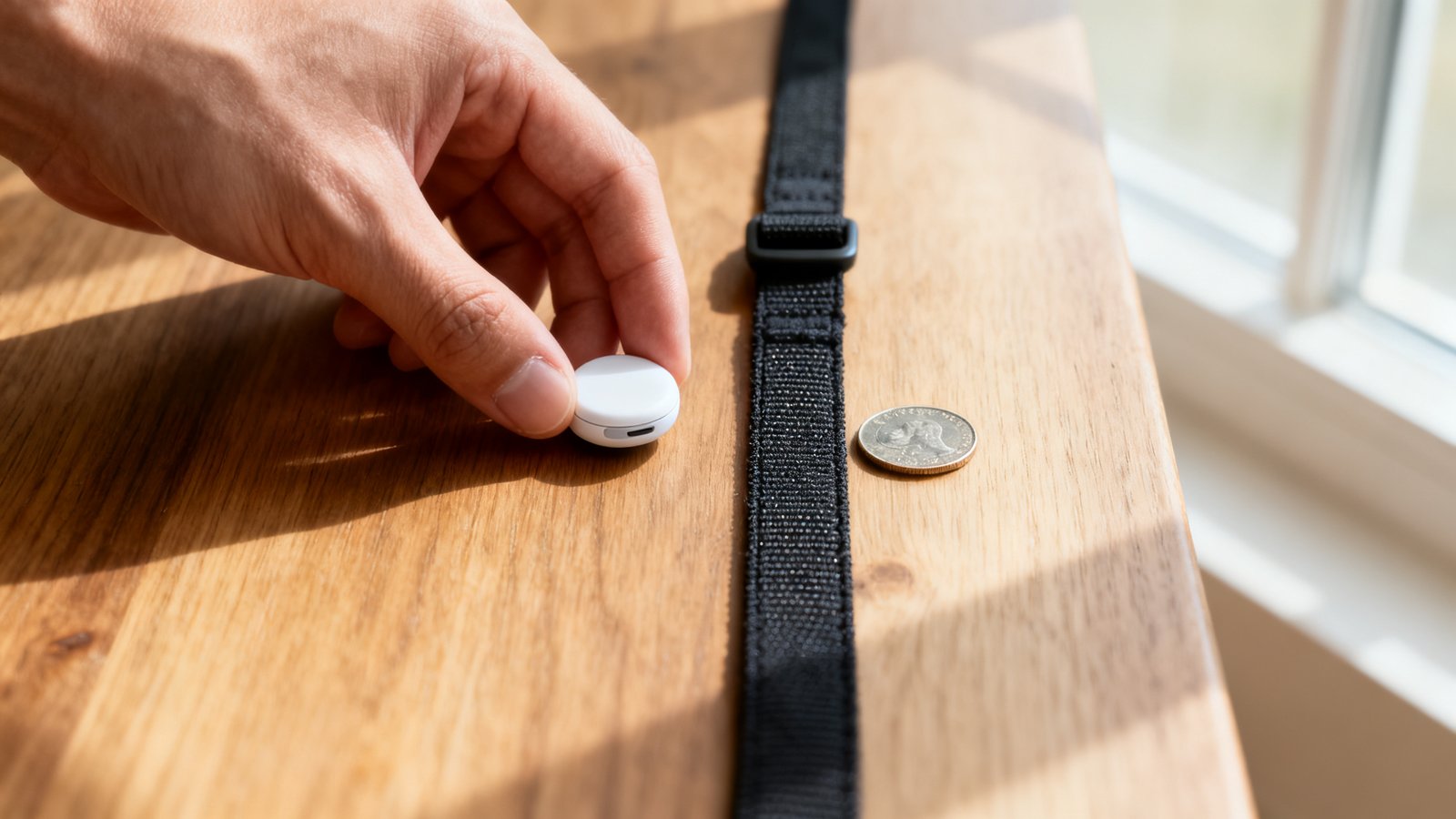
Weights listed are device only unless otherwise noted. Collar mounts and attachment sleeves typically add another 5 to 20 grams. On a 2 pound dog, that extra mount weight matters.
| Rank | Device | Device Weight | Dimensions | % of 2 lb Dog | % of 4 lb Dog | Type |
|---|---|---|---|---|---|---|
| 1 | Apple AirTag | 0.39 oz (11 g) | 1.26 in dia. x 0.31 in | 1.2% | 0.6% | Bluetooth / Find My |
| 2 | Fi Mini | 0.5 oz (14 g) | Smaller than Series 3* | 1.6% | 0.8% | LTE-M GPS |
| 3 | Jiobit Smart Tag | 0.6–0.8 oz (17–23 g) | 1.5 x 1.5 x 0.47 in | 1.9–2.5% | 0.9–1.2% | Cellular / WiFi / BT |
| 4 | Fi Series 3 | 0.7–0.8 oz (20–23 g) | 1.8 x 1.0 x 0.4 in | 2.2–2.5% | 1.1–1.2% | LTE-M GPS |
| 5 | Tractive GPS LTE Mini | 1.0 oz (28 g) | 2.1 x 1.1 x 0.6 in | 3.1% | 1.6% | LTE GPS |
*Fi Mini exact dimensions not published by manufacturer as of 2026 testing. Fi describes it as smaller than the Series 3 module.
The veterinary guideline for small animals recommends keeping collar mounted devices under approximately 5% of body weight to minimize neck strain and gait interference. Every tracker above clears that threshold even for a 2 pound teacup dog. The Tractive Mini at 3.1% on a 2 pound dog is the heaviest relative load but still safe by that standard. On a 4 pound Chihuahua, none exceed 1.6%.
For context, a typical adult Chihuahua weighs 4 to 6 pounds. “Teacup” is not an official breed standard but commonly describes dogs in the 2 to 4 pound range. This is the most physically constrained use case in the pet tracker market. You cannot simply downsize a hunting collar antenna and expect it to work on a 3 pound dog.

True GPS vs Network Tags: What Small Dog Owners Must Know
The phrase “GPS tracker” gets thrown around loosely. Two of the five devices in our table above are not GPS trackers at all in the technical sense. The Apple AirTag relies entirely on Bluetooth and Apple’s crowdsourced Find My network. It has no satellite positioning chip, no cellular radio, and no ability to report its own location without a nearby iPhone. This distinction determines whether your tracker actually helps when your dog bolts through a gap in the fence.
A true GPS tracker (Fi Mini, Tractive Mini, Jiobit, Fi Series 3) contains a GPS receiver plus a cellular modem (LTE or LTE-M). It determines its own coordinates and transmits them over the mobile network to your phone. You get active, live location data regardless of whether anyone else walks by. A network tag (AirTag, Tile, Chipolo) passively pings off nearby devices and reports location only when a participating phone comes within Bluetooth range.
For urban apartment owners like Emma, the AirTag works well because the density of iPhones in a city creates near continuous coverage. If your Chihuahua slips out the lobby door in Manhattan, someone’s phone will register that tag within minutes. If the same dog escapes at a rural cabin with the nearest neighbor half a mile away, the AirTag becomes a plastic disc that tells you nothing.
Our how to choose GPS tracker dog guide covers the cellular versus Bluetooth decision in more depth, but the short version for small breed owners is this: if you ever leave the city with your dog, you need actual GPS with cellular. If you never leave a dense urban core, an AirTag saves weight, money, and charging hassle.
Android compatibility also splits these devices. AirTag tracking on Android is limited to basic NFC scanning. The Find My network is an Apple ecosystem. Fi, Tractive, and Jiobit all work on both platforms through their respective apps.
Real World Battery Life for Lightweight GPS Collars
Published battery specs are almost always optimistic. Real world use on a small dog who goes on two daily walks with occasional live tracking sessions produces very different numbers. Here is what independent testing and aggregated user reviews actually show for 2026.
Bluetooth and Find My tags sit in one category. The Apple AirTag uses a user replaceable CR2032 coin cell that lasts roughly 6 to 12 months in dog use. There is no GPS chipset drawing power and no cellular transmission. Replacements cost pennies and take seconds.
LTE GPS trackers live in a completely different reality. The Fi Mini stands out here. Treeline Review’s 2026 testing documented approximately 6 weeks of battery life under mixed use, significantly better than the category average. For comparison, the Tractive GPS LTE Mini typically lasts 2 to 7 days with frequent live tracking activated and up to about 10 days with energy saving modes enabled. The Jiobit falls in the 3 to 7 day range when used actively.
Across the category, practical battery life for LTE GPS collars used on small dogs with normal daily activity (one or two walks plus occasional live tracking) averages 1 to 3 weeks for most brands. Fi Mini at 4 to 6 weeks is the outlier on the high end.
Battery complaints dominate negative reviews. Roughly 20 to 40 percent of low star reviews for cellular GPS trackers reference battery drain, faster than advertised depletion, or degradation after the first year. This is rarely a manufacturing defect. It is usually the result of poor cellular signal forcing the tracker to transmit at higher power for longer periods. Our Tractive GPS review digs into how signal strength directly impacts daily battery consumption on budget LTE devices.
Feature Gaps Between Budget and Premium Mini Trackers
Small, lightweight trackers under $150 make deliberate engineering tradeoffs. They are small because they leave things out. Here is what gets cut and who actually cares.
Advanced activity and health metrics disappear first. AirTag records nothing about your dog’s movement. Basic Tractive and Jiobit tiers may track activity duration but skip sleep quality, breed specific baselines, and health trend alerts. Premium devices like the full Fi ecosystem and higher Whistle tiers add detailed step counts, calorie estimates, and anomaly detection. For a comfort focused urban owner, this is noise. For someone tracking an aging Chihuahua with a heart condition, those metrics become relevant.
Live tracking refresh speed also splits the market. High end units (SpotOn, Garmin hunting collars, premium Fi modes) update GPS position every 1 to 15 seconds. Budget mini trackers refresh every 30 seconds to 5 minutes, and some only activate frequent updates when you manually trigger lost mode. If your dog is sprinting down a street, a 5 minute old position is nearly useless.
Geofencing gets thinner too. Premium devices support multiple customizable safe zones with smart notifications. Budget units often cap at one or two zones with slower alert delivery. Some mini trackers skip geofencing entirely.
Waterproofing and ruggedness also vary. The Fi Mini carries an IP68 rating (submersion rated). AirTag is water resistant but not swim proof. If your small dog never swims, this gap is academic. For a dog who regularly jumps into ponds, it becomes a durability question.
Read our Fi vs Halo collar comparison to see how these feature tradeoffs play out between two premium brands, and check the Fi smart collar review for a detailed breakdown of what the premium tier actually delivers for small breeds.
Physical Safety Concerns for Dogs Under 10 Pounds
Physical complaints about trackers on tiny dogs cluster around specific issues. Neck irritation and hair loss appear when a tracker plus collar combine to press on a small contact area over hours of daily wear. Owners of 3 to 6 pound dogs report redness, scratching, and reluctance to wear the collar. This is more common with devices in the 1 to 1.5 ounce range mounted on relatively thick collar straps.
Bulk interfering with movement shows up as the dog pressing its chin against a rectangular module when lowering its head to eat or drink. Long trackers can knock against the jaw during running. Some dogs visibly alter their gait or head posture. Dangling mounts catch on crate wires, furniture legs, underbrush, and other dogs’ mouths during play. For toy breeds, a snagged tracker becomes a choking or strangulation hazard faster than it would for a 50 pound dog.
Skin reactions to silicone or plastic housings and heat buildup under non breathable mounts are also reported, though these are more comfort issues than acute safety threats.
The devices with the fewest physical complaints in small dog use are the Apple AirTag (0.39 oz disc, low profile collar mounts available), the Fi Mini (0.5 oz, integrated on a slim collar with no dangling parts), and the Jiobit (attaches to harness D rings, distributing weight off the neck entirely). Treeline Review’s 2026 testing explicitly calls the AirTag a top pick “for very small dogs (and even cats)” based on weight and form factor.
Heavy hunting collars like the Garmin Alpha T 20 (8.4 ounces with antenna and collar) and multi antenna virtual fence devices like SpotOn are clearly not designed for dogs under 10 pounds and generate the most small dog discomfort complaints.
Subscription Coverage and Hidden Costs Compared
Small dog owners often buy based on device weight and price, then discover the recurring costs later. Here is exactly what the three lightest trackers actually cost over time.
| Cost Factor | Apple AirTag | Fi Mini | Tractive Mini |
|---|---|---|---|
| Device Cost | $29 | Free with subscription | $49 to $69 |
| Subscription | None | $19/month or $189/year | $5 to $12/month |
| 2 Year Total | ~$29 plus mount | ~$339 (biennial plan) | ~$170 to $350 |
| Network Type | Apple Find My (crowdsourced) | AT&T LTE-M | Multi carrier LTE |
| Hidden Costs | Collar mount ($5 to $15), iPhone required | Battery degrades over years, device replacement needed | Premium features paywalled, roaming fees for travel |
The Fi Mini’s “free device with subscription” model sounds appealing but locks you into a two year commitment at $339. The Tractive Mini costs more upfront but offers a lower monthly rate. The AirTag has no recurring cost at all but also no GPS and no cellular. Treeline’s 2026 GPS collar roundup notes that the Fi subscription “may surprise users expecting a modest monthly fee.”
Watch for activation fees, promotional pricing that jumps after year one, international roaming charges if you travel with your dog, and premium feature paywalls that hide advanced activity data or unlimited geofences behind higher tier plans.
Reliability and Failure Modes in Mini GPS Trackers
No manufacturer publishes formal failure rate data for consumer pet trackers. What exists are aggregated review patterns, anecdotal reports, and comparative observations from independent testers.
Mini trackers have smaller antennas and smaller batteries than their large dog counterparts. This creates predictable weak points. Signal loss is more common in dense urban environments, underground spaces, and deep tree cover. Location update delays of 10 to 30 minutes appear in negative reviews across Fi, Tractive, and Jiobit. These delays are usually a combination of aggressive power saving algorithms and weak cellular signal rather than hardware failure.
Water damage still occurs despite IP67 and IP68 ratings, especially after repeated saltwater exposure or when charging port covers degrade over time. Complete device failure after one to two years is typically related to battery degradation or corroded charging contacts, not catastrophic waterproofing failure.
Perceived failure in real world use (tracker shows wrong location or no updates when the owner needs it most) is reported more frequently with consumer grade LTE mini trackers than with professional grade large dog collars used by hunters. But this is partly a difference in user expectations. A hunter expects to manage a complex device. A pet owner in a panic expects a single button that works instantly.
After purchase, run a signal test in the locations your dog actually frequents. Walk your neighborhood and check update frequency. If the tracker advertises waterproofing, do a controlled swim test on a leash before trusting it in open water. Stress test the difference between “last known location” and real time tracking by having someone else carry the device while you monitor the app.
Content Gaps Other Guides Miss
Top ranking “best GPS for small dogs” articles from 2025 and 2026 cover weight, battery life, and basic fit at a high level. They almost never address the following topics, which are precisely what owners of sub 10 pound dogs need to know:
Harness attachment options specific to toy breeds. Most trackers assume a standard 5/8 to 1 inch collar strap. A Chihuahua might wear a 3/8 inch micro collar. No major guide provides a compatibility table showing which tracker mounts work with which strap widths. Harness mounting (preferable for tracheal safety in toy breeds) gets even less coverage.
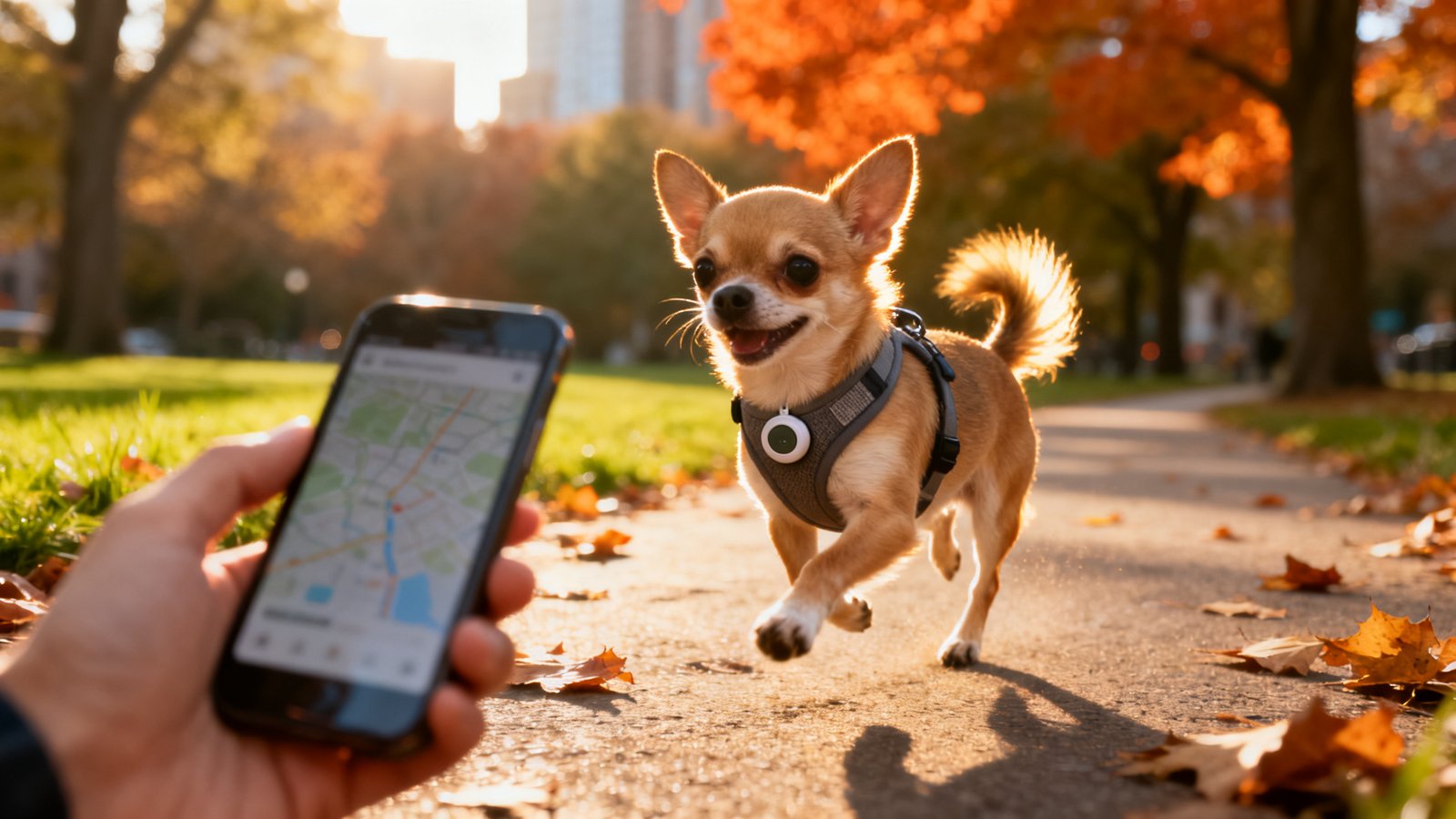
Tracheal collapse risk. Toy breeds, especially Chihuahuas, are predisposed to tracheal collapse. A collar mounted tracker plus an ID tag plus a rabies tag on a narrow collar creates concentrated pressure on the trachea when the dog pulls. Harness mounting distributes this load across the chest. This is a veterinary consideration that no top ranking buyer’s guide addresses.
Tracker shedding and snagging prevention. Redundant tethers, sewn pouches, split ring backups, and snag tests against common obstacles (crate bars, fence gaps, under furniture) are absent from most guides. For a 3 pound dog, a snagged tracker is not an inconvenience. It is an emergency.
Stacking with existing tags. A tiny dog’s collar D ring might already hold an ID tag and a rabies tag. Adding a tracker creates a jingling cluster that catches more easily and concentrates more weight on one small neck point. Guides rarely discuss tag management alongside tracker mounting.
The best GPS tracker for dogs 2026 guide on our site addresses some of these hardware compatibility questions, but the industry as a whole has a blind spot here. Small dogs are not just smaller targets for the same product. They need different mounting engineering entirely.
Practical Buying and Fitting Checklist for Small Dogs
Use this checklist during the first 72 hours after buying any tracker for a dog under 10 pounds. These steps catch most comfort and safety issues before they become problems.
- Measure neck circumference. Use a soft tape measure. Note the exact collar width your dog currently wears. Check whether the tracker’s mount or pass through loops accept that width.
- Calculate the tracker percentage of body weight. Total tracker plus mount plus collar weight divided by dog weight. Target under 5% for a 2 pound dog and under 3% ideally for everyday comfort.
- Do a 15 minute supervised walk test. Watch for rotation (tracker shifting to the side), gait changes, head posture changes, and any pawing or scratching at the device. Record video in slow motion if possible.
- Test attachment snag risk. Guide your dog past crate bars, under a low chair, and along a fence line while wearing the tracker. Watch for any catching or hesitation.
- Prefer harness mounting over collar mounting for toy breeds. Attach the tracker to the back D ring area of a well fitted harness. This removes all tracheal pressure and distributes weight across the chest.
- Verify location update speed. Have someone walk the dog 200 feet away while you monitor the app. Note the delay between actual movement and screen update. Test in both open areas and near buildings.
- Run a one week battery baseline. Charge to full, use normally (two daily walks, one live tracking test), and record the percentage remaining after 7 days. This gives you a realistic sense of your actual charge interval.
Recommended Picks by Use Case
Urban apartment, comfort first owner: Apple AirTag. At 0.39 ounces with no subscription and a 6 to 12 month battery, this is the lightest and cheapest option. It works in dense urban environments where iPhones are everywhere. It does not track your dog in real time if they escape into a rural area. For a city only Chihuahua, that tradeoff often makes sense. Treeline Review confirms this recommendation for “very small dogs (and even cats).”
Best balance of GPS tracking and long battery for small dogs: Fi Mini. At 0.5 ounces with tested 6 week battery life, this is the smallest true GPS tracker available. The LTE-M connectivity provides live location tracking without the daily charging burden of most competitors. The subscription is expensive at $19 per month or $189 per year, but the hardware is free and the battery performance is unmatched in the mini category. Read our Fi smart collar review for the full breakdown.
Affordable true GPS with multi carrier coverage: Tractive GPS LTE Mini. At approximately $49 to $69 for the device plus $5 to $12 per month, this is the lowest entry price for actual GPS tracking on a small dog. The 2 to 7 day battery life means frequent charging, and the device is the heaviest in our mini list at 1.0 ounce. But for owners who need GPS coverage across multiple countries or on a tighter budget, Tractive delivers.
Escape prone dog in suburban or mixed terrain: Fi Mini or Fi Series 3. If your dog is a known escape artist, you need faster update intervals and reliable geofencing. The Fi ecosystem delivers both, and the Mini variant keeps the weight manageable. The tradeoff is the locked subscription. For a dog who bolts quarterly, that cost may be worth the peace of mind.
Our best GPS tracker for dogs 2026 guide includes additional options with no subscription models if you want to avoid recurring fees entirely, though those devices tend to be larger.
Conclusion
Choosing a GPS tracker small dogs can wear safely means starting with the gram count and working outward from there. The Apple AirTag wins on weight and simplicity but loses on rural tracking and real time updates. The Fi Mini wins on battery life and true GPS capability in the smallest possible package. The Tractive Mini wins on upfront cost and international coverage. The Jiobit splits the difference on weight with a harness friendly form factor.
Whichever device you pick, test it on your dog’s actual body with their actual collar or harness in your actual environment. A spec sheet cannot tell you whether the mount will snag on your specific furniture or whether the GPS updates fast enough for your neighborhood’s layout. Run the 72 hour checklist above. If the tracker shifts, snags, or drains faster than expected, return it and try the next option. Your dog’s comfort and safety are the real specs that matter.
Ready to choose? Compare the full field of 2026 GPS trackers in our best GPS tracker for dogs 2026 guide or dive deep into the Fi Mini with our Fi smart collar review.
Frequently Asked Questions
What is the lightest GPS tracker for a 3 pound Chihuahua?
The Apple AirTag at 0.39 ounces (11 grams) is the absolute lightest tracking device available. However, it is not a true GPS tracker. It uses Bluetooth and Apple’s Find My network. For actual GPS with cellular, the Fi Mini at 0.5 ounces (14 grams) is the lightest option. Both are well under the veterinary guideline of 5% body weight for even a 2 pound dog.
Can I use an AirTag instead of a GPS collar for my small dog?
In urban and suburban areas with high iPhone density, yes. The AirTag will be detected by nearby Apple devices and its location reported through the Find My network. In rural areas, on trails, or anywhere with sparse population, an AirTag becomes nearly useless because there are no devices to relay its position. It also provides no real time tracking or escape alerts. It is a finding tool, not a monitoring system.
How often do I need to charge a mini GPS dog tracker?
It varies significantly by model and usage. The Fi Mini lasted about 6 weeks in independent 2026 testing under mixed use. The Tractive GPS LTE Mini typically lasts 2 to 7 days with active live tracking. Most other LTE GPS mini trackers fall in the 1 to 3 week range under normal daily use. Bluetooth tags like the AirTag need a battery change every 6 to 12 months.
Is a collar or harness better for attaching a tracker to a toy breed?
A harness is strongly preferred for toy breeds, especially Chihuahuas who are predisposed to tracheal collapse. A harness distributes the tracker’s weight across the chest instead of concentrating it on the trachea. It also reduces the risk of the tracker snagging and pulling on the neck. Attach the tracker to the back D ring area of a properly fitted harness whenever possible.
Are there any GPS trackers that work without a monthly subscription?
The Apple AirTag has no subscription fee and uses the free Find My network. For true GPS trackers without monthly fees, options are limited. Some budget devices offer limited no subscription functionality using Bluetooth only, but reliable cellular GPS tracking almost always requires a subscription to cover the mobile data costs. Our best GPS tracker for dogs 2026 guide covers the handful of no subscription alternatives that exist in the current market.