

If you have ever stood in the pet tech aisle or scrolled Amazon at midnight wondering how to choose GPS tracker dog gear that actually works when it matters, you are not alone. The market is flooded with shiny marketing claims, but beneath the surface are real tradeoffs in battery life, network reliability, and subscription costs that most buying guides skip right over. This guide is different. It is built from aggregated user complaint data, independent field tests, and technician level breakdowns of what fails and why so you can make one confident decision and never look back.
Key Takeaways
- Cellular GPS trackers provide real time global coverage but cost $200 to $400 more than Bluetooth alternatives over two years after subscriptions are included.
- Aggregated negative reviews show battery complaints rank first, followed by connectivity reliability and false escape alerts, making these your most important vetting criteria.
- The single most overlooked spec is network technology: LTE M and NB IoT radios dramatically improve battery life and protect against carrier sunset obsolescence.
Table of Contents
- Cellular vs. Bluetooth — pick the right technology for your use case
- What most buyers get wrong — the top complaints and failure modes you will want to avoid
- Real world battery life and the true 2 year cost comparison
- Network tech and sunset risk — why LTE M / NB IoT and band support matter
- Waterproof ratings and physical durability — read beyond waterproof
- Live tracking performance — ping intervals, tracking radius, and history retention
- Firmware cadence, app updates, and security transparency — what to demand before buying
- Safety and behavior — beeps, vibration vs. silent models, and documented harms
- Attachment and breed specific fit — solving long fur and small dog comfort issues
- Privacy, data retention, and subscription economics — read the fine print
- Content gaps competitors ignore — three undervalued topics you should cover
- 10 point actionable buyer checklist (the last page to keep on your phone)
- Quick, practical recommendations by user scenario
- Sources and how we measured these claims (short transparency note)
Cellular vs. Bluetooth — pick the right technology for your use case
The first fork in the road when learning how to choose GPS tracker dog equipment is deciding between cellular GPS and Bluetooth crowd network trackers. They solve fundamentally different problems, and picking the wrong one is the most expensive mistake you can make.
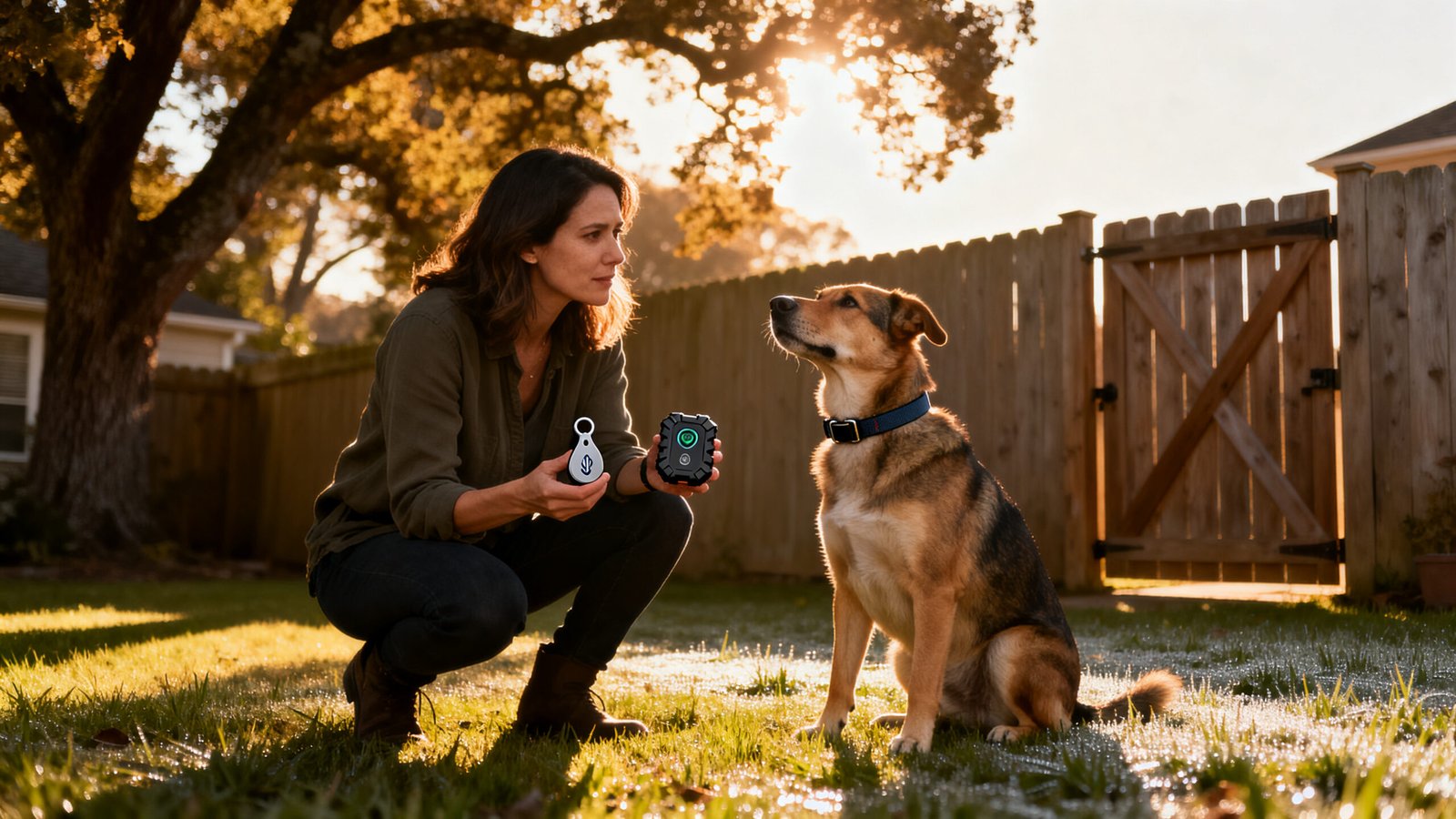
Cellular GPS trackers like the Fi Series 3, Tractive, and Whistle contain their own SIM card and GNSS receiver. They report location anywhere there is cellular coverage, independent of other people or phones nearby. This makes them the only credible choice for rural areas, hiking trails, and escape prone dogs that could end up miles from the nearest iPhone. The tradeoff is battery life and recurring subscription fees.
Bluetooth tags like the Apple AirTag, Tile, and Samsung SmartTag operate on a completely different principle. They do not have GPS. They do not have cellular radios. Instead, they emit a low energy Bluetooth signal that nearby phones detect and relay anonymously through a crowd network. This design gives them astonishing battery life, roughly 9 to 12 months on a single coin cell, and zero mandatory subscription costs. But the catch is existential: if your dog runs into a field, a wooded area, or anywhere without a critical density of phones, that AirTag goes silent. It is not tracking anything. It is waiting for a phone that may never pass by.
Decision rules for Sarah and readers like her: if your dog stays in a suburban neighborhood with high iPhone density and you want a low cost local finder for occasional yard escapes, a Bluetooth tag is a reasonable backup layer. If your dog is rural, hunts, hikes, or has a history of bolting beyond the subdivision, you need cellular GPS. Period. The two year cost delta of roughly $200 to $400 more for cellular is simply the price of real time global coverage.
We cover specific models and their real world performance in our best GPS tracker for dogs 2026 comparison, including subscription free alternatives worth considering.
What most buyers get wrong — the top complaints and failure modes you will want to avoid
Aggregated data from Amazon reviews, Consumer Reports comparative testing, and long term field reviews paint a brutally consistent picture of what goes wrong. When you know the failure modes, you know exactly what to look for in a dog GPS tracker before you spend a dime.
The top eight complaint categories ranked by frequency across all major brands are:
- Battery life far shorter than advertised — real world drain in live tracking mode can empty a device in hours, not days.
- Connectivity and location reliability — GPS drift showing dogs miles away, long periods with no fix, and laggy handoffs between Wi Fi, Bluetooth, and cellular.
- False or missing escape alerts — alerts firing when the dog is asleep at home, or worse, total silence when the dog actually bolts through the geofence.
- App and software usability — confusing menus, crashes, and activity stats that bear no resemblance to reality.
- Hardware durability failures — broken attachment clips, water ingress despite waterproof marketing, and corroded charging contacts.
- Subscription and cost grievances — bait and switch perceptions where low hardware prices hide mandatory recurring fees.
- Customer support issues — slow responses, warranty denials after water damage, and costly return shipping requirements.
- Size, fit, and comfort problems — devices too bulky for small dogs or causing fur matting on long coat breeds.
Each of these translates into a concrete buyer red flag. If a product page does not state its IP rating explicitly, assume it will fail in water. If it does not disclose its radio bands, assume it is running on legacy hardware nearing obsolescence. If the attachment mechanism looks flimsy in product photos, it will fail in brush. Our Fi smart collar review goes deep on attachment durability issues, particularly the Series 2 D ring failures that caused lost devices.
Real world battery life and the true 2 year cost comparison
Marketing battery claims are measured in ideal laboratory conditions. Real dogs roll in mud, wander into weak signal zones, and trigger live tracking modes that guzzle power. Here is what independent field testing and aggregated user reports actually show for suburban and rural use.
| Brand / Model | Suburban Real World | Rural Real World | 2 Year Total Cost (Device + Sub) |
|---|---|---|---|
| Fi Series 3 | ~2 to 3 weeks | ~7 to 10 days | ~$342 to $390 |
| Tractive GPS | ~3 to 5 days | ~2 to 4 days | ~$194 to $310 |
| Whistle | ~5 to 10 days | ~3 to 5 days | ~$340 to $442 |
| Cube GPS | ~3 days | ~2 to 3 days | ~$438 to $530 |
| Apple AirTag (Bluetooth) | 9 to 12 months | 9 to 12 months | ~$29 + battery swaps |
The pattern is stark: suburban dogs with Wi Fi safe zones stretch battery life significantly, while rural dogs burning LTE transmit power get roughly half the advertised duration. And when live tracking mode kicks in, all bets are off. The ACDRA documented devices that “don’t even last 24 hours” under continuous GPS load, a finding consistent across multiple brands. This GPS tracker buying guide pets owners need must account for these real world drains, not the box claims.
Network tech and sunset risk — why LTE M / NB IoT and band support matter
This is the section most buying guides skip entirely, and it is where long term reliability is won or lost. Understanding GPS tracker dog features explained at the radio level is not esoteric. It determines whether your $150 device becomes a paperweight in two years when a carrier shuts down its legacy network.
Modern pet trackers use one of two cellular technologies: legacy LTE (Cat 1 or older) or low power wide area standards like LTE M (Cat M1) and NB IoT. LPWA modems offer three critical advantages. They use dramatically less power because they transmit in short bursts at lower peak current. They penetrate buildings and foliage better in many deployments. And most importantly, they ride on network infrastructure that carriers have committed to supporting long term as part of their IoT roadmaps.
The 3G sunsets completed by major US carriers in 2022 and 2023 rendered thousands of older pet trackers unusable overnight. Devices that relied on 2G or 3G bands simply stopped connecting. The same pattern will repeat as carriers gradually re farm older LTE spectrum for 5G expansion. A tracker purchased today that runs on legacy LTE without LTE M or NB IoT fallback is buying into planned obsolescence.
What to look for in a dog GPS tracker spec sheet: explicit mention of LTE M (Cat M1) or NB IoT support. If the product page only says “4G” or “LTE” without specifying the category, dig deeper. Jiobit and newer Tractive revisions explicitly advertise Cat M. Fi and Whistle have moved toward LTE M in recent hardware generations. If a cheap Amazon brand cannot tell you what radio is inside, that silence is your answer.
For a deeper comparison of how Fi handles connectivity versus competitors, our Fi vs Halo collar breakdown covers network behavior in different coverage environments.
Waterproof ratings and physical durability — read beyond waterproof
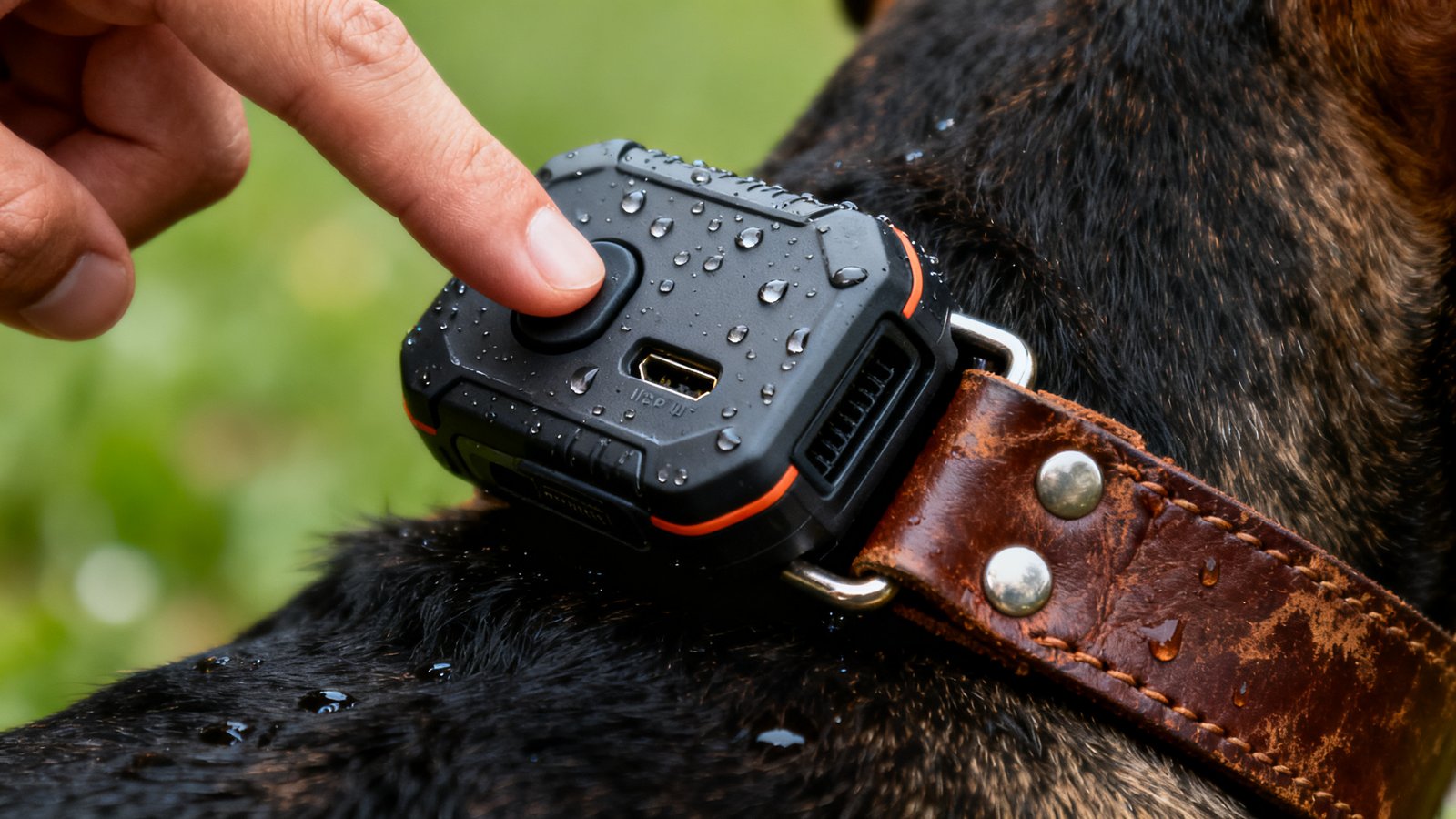
The word “waterproof” on a product box is legally meaningless without an IP rating behind it. Yet multiple popular trackers use that exact word while failing spectacularly in real swimming conditions. FitBark GPS, for example, claims waterproofing but provides no IP rating whatsoever, leading independent testers to express “serious doubts” about submerged performance, as documented in the Jakobagsds field test of multiple GPS trackers. Cube GPS is explicitly noted as not waterproof at all and should be avoided for any dog that swims.
Here is the quick decoder for what to look for in a dog GPS tracker regarding ingress protection:
- IPX7 means immersion to 1 meter for 30 minutes but zero dust protection. The X is not a feature. It means the device was never tested for dust ingress. Fine for a house dog. Not fine for sandy trails or muddy yards.
- IP67 adds full dust tightness plus the same 1 meter and 30 minute water immersion. This is the practical minimum for active dogs.
- IP68 adds deeper or longer immersion ratings specified by the manufacturer. This is what swimming dogs and water retrievers need.
Beyond the rating, inspect product photos for the charging port cover design. A flimsy rubber flap that looks like it will fatigue after 50 charge cycles is a water ingress point waiting to happen. Corroded charging contacts are one of the most common long term failure reports across every brand. Our Tractive GPS review covers charger wear patterns that users report after six plus months of daily use.
Live tracking performance — ping intervals, tracking radius, and history retention
When your dog is actually running through traffic or disappearing into woods, the difference between a 3 second ping and a 60 second ping is the difference between catching up and guessing which direction they went. Best GPS tracker features for dogs in live mode are not about the app interface. They are about the raw update interval.
Tractive leads the pack with advertised LIVE updates every 2 to 3 seconds, and real world tests consistently show 3 to 5 second refresh rates, as confirmed by long term YouTube field testing by Kelley’s Country Life. That is genuinely useful for real time pursuit. Fi Series 3 in Lost Dog Mode delivers roughly 15 to 30 second updates. Jiobit claims about 10 seconds but real tests show 10 to 30 seconds depending on power mode and coverage. Whistle sits around 30 to 60 seconds in tracking mode. FitBark GPS intended to provide roughly 60 second intervals but field testers observed inconsistent and longer gaps with no countdown timer, leaving users “stuck waiting and refreshing the app.”
History retention matters too. Tractive stores up to 365 days of location breadcrumbs. Fi retains multi month history. Whistle keeps at least 30 days. AirTag, by contrast, has no continuous historical path at all. It shows current or last seen location and nothing in between. If you want to understand your dog’s patterns or prove a repeat escape route to a neighbor, history retention is not optional.
This GPS tracker buying guide pets owners rely on must emphasize that faster ping rates burn battery faster. Tractive at 3 to 5 second live updates will drain in hours. That is the engineering tradeoff: you get precision response when you need it most, but you cannot leave it in live mode all day.
Firmware cadence, app updates, and security transparency — what to demand before buying
Pet trackers are location surveillance devices attached to your dog and linked to your home Wi Fi. Their security posture matters, yet most manufacturers publish generic “bug fixes and improvements” without meaningful detail. Over the past 12 months, Fi, Whistle, Tractive, and Cube each pushed roughly 2 to 4 firmware updates and 8 to 15 app updates annually. Almost none of them publish CVE style security disclosures. Apple’s AirTag, by contrast, released 1 to 3 firmware updates with explicitly documented anti stalking and security enhancements.
When evaluating a tracker as part of your GPS tracker buying guide pets research, look for a public changelog. If the company cannot be bothered to tell you what changed in the last firmware push, assume their security practices are similarly opaque. Acceptable vendor behavior includes monthly app updates, regular firmware patches with at least summary level notes, and a privacy policy that names data retention periods by field, not just vague commitments.
| Brand | Firmware Updates (12 months) | App Updates (12 months) | Security Transparency |
|---|---|---|---|
| Fi | ~2 to 4 | ~Monthly | Some security notes, no CVE detail |
| Whistle | ~2 to 4 | ~10 to 15/year | Sparse critical patch disclosure |
| Tractive | ~2 to 3 | ~Monthly | Occasional backend security mentions |
| Apple AirTag | ~1 to 3 | OS integrated | Clear anti stalking and CVE documentation |
Safety and behavior — beeps, vibration vs. silent models, and documented harms
Veterinary behaviorists and professional trainers draw a clear line: GPS tracker dog features explained in the context of behavioral safety come down to whether the device includes aversive outputs. Silent only GPS trackers pose minimal direct behavioral risk. They are passive logging and location devices. The risks are mechanical: collar fit, weight, choking hazard if pieces are ingested.
Trackers with audible beeps or vibration alerts sit in a gray zone. Behaviorists consider them lower risk than shock collars, but unpredictable beeping can still cause startle responses and anxiety, particularly if the dog associates the sound with a scary event. The recommendation from training professionals is consistent: if your tracker has beep or vibration features, use them only as positively trained recall cues, never as punishment or random alerts.
Documented harm incidents are overwhelmingly mechanical, not electronic. The Fi Series 2 collar had numerous reports of D ring hardware failures where the leash attachment point broke, causing dogs to escape. Skin irritation and pressure sores occur across brands when devices are worn too tightly. There are occasional reports of dogs chewing off and ingesting tracker pieces, particularly smaller units like AirTags and Tiles. There is no central evidence of RF radiation causing physiological harm at the exposure levels used in pet trackers. The risk is in the hardware, not the radio waves.
For more on collar safety and fit considerations, our Halo Collar 3 review covers virtual fence collar safety assessments that apply broadly to any collar mounted device.
Attachment and breed specific fit — solving long fur and small dog comfort issues
Negative reviews consistently cite size, fit, and fur matting as persistent problems that top competitor articles rarely test for. This is a major gap in what to look for in a dog GPS tracker if you own a long coat or double coat breed like a Collie, Newfoundland, or Husky.
Attachment systems fall into three categories: integrated collars where the tracker is built into a proprietary band, slide on designs that thread onto an existing collar, and clip mounts that snap over the collar strap. Integrated collars like the Fi system offer the most stable GPS orientation but lock you into buying replacement bands from the manufacturer. Slide on designs work with more collar types but can rotate on long fur, degrading GNSS reception and causing uneven pressure. Clip mounts are convenient but have the highest loss rate in brush.
For long coat dogs, consider shaving a small patch under the tracker location to improve skin contact and reduce matting. Rotate the device position slightly each week to prevent persistent pressure on one spot. And if the tracker weighs more than roughly 2 percent of your dog’s body weight, it is too heavy. Small dogs under 10 pounds need trackers specifically designed for their size. Cube, older Whistle units, and early Fi models drew frequent complaints for bulk on small breeds.
Privacy, data retention, and subscription economics — read the fine print
A GPS tracker buying guide pets owners can trust must address what happens to the location data after it leaves the device. Most privacy policies for pet tracker companies allow data sharing with service providers and analytics partners. Few prominently disclose retention periods by data field.
Subscription tiers directly affect what features you get and how long your data lives. Tractive retains up to 365 days of location history on paid plans. Whistle keeps at least 30 days of location data but stores health metrics longer. Fi retains multi month histories but does not publish strict retention limits. If you cancel your subscription, assume historical data access disappears, even if the company retains backend copies.
Compute your true two year ownership cost by adding the device price, 24 months of subscription at the annual prepay rate, and one replacement attachment or charger if reviews suggest durability issues. For Fi Series 3, that lands around $342 to $390. For Tractive, $194 to $310. Whistle sits at $340 to $442. Over two years, Bluetooth alternatives cost roughly $25 to $30 plus a couple of coin cell batteries. That $200 to $400 cellular premium is the price of real time independent tracking. Whether it is worth it depends entirely on your dog’s escape risk profile.
Content gaps competitors ignore — three undervalued topics you should cover
A gap analysis of the top 20 search results for dog GPS tracker buying guides reveals three subtopics that are almost completely ignored, yet matter deeply to owners asking what to look for in a dog GPS tracker.
First: interaction with implanted microchips. Many owners worry that a collar mounted GPS tracker might interfere with their dog’s RFID microchip. Technically, there is no documented interference risk. Pet microchips operate at 134.2 kHz and are passive, energizing only when a scanner is placed directly adjacent. GPS trackers use GNSS bands around 1.5 GHz, BLE at 2.4 GHz, and LTE at various bands. The systems are spectrally distinct. Your vet will still be able to read the chip. But the fact that no major buying guide addresses this concern is a trust gap.
Second: attachment solutions for long fur and heavy coat breeds. As covered above, this is a real comfort and performance issue that most reviews gloss over with “fits most collars.” It deserves its own testing protocol.
Third: a taxonomy of false alerts. Not all false alerts are created equal. Wi Fi dropout false alarms occur when your home network flickers and the tracker thinks the dog left the safe zone. GPS drift false alarms show the dog blocks away when it is actually asleep. App backgrounding failures produce silent non alerts where the dog escapes but the notification never fires because the app was killed by the phone OS. Understanding which type you are experiencing is the first step to fixing it. Mitigation strategies include setting a slightly larger geofence radius to absorb GPS drift, ensuring the tracker app has background refresh permissions enabled, and testing your Wi Fi safe zone reliability by simulating an escape drill.
10 point actionable buyer checklist (the last page to keep on your phone)
After all the data, here is a prioritized checklist of verifiable specs and behaviors to demand before purchase. This is your how to choose GPS tracker dog cheat sheet.
- Radio technology: Must specify LTE M (Cat M1) or NB IoT support. Reject “4G” only descriptions without category detail.
- IP rating: Minimum IP67 for active dogs. IP68 for swimmers. Reject any product that says “waterproof” without a published rating.
- GNSS constellation support: GPS plus at least one of GLONASS, Galileo, or BeiDou improves fix speed and accuracy in tree cover.
- Live ping interval: Target 10 seconds or faster for serious escape recovery. Tractive achieves 3 to 5 seconds. Fi delivers 15 to 30 seconds. Anything over 60 seconds is inadequate for real time pursuit.
- History retention: Minimum 30 days of location breadcrumbs. Prefer 365 days if you want pattern analysis.
- Firmware transparency: Public changelog with at least summary level release notes. Avoid brands with zero documentation of what updates actually changed.
- Battery: Know whether it is replaceable or sealed. Sealed batteries mean the entire device is disposable when capacity degrades, typically after 2 to 3 years.
- Attachment durability: Rated for leash use if integrated. Check reviews specifically for clip and D ring failure reports.
- Total 2 year cost: Sum device plus 24 month subscription. Set a cap before you start shopping so marketing does not push you over budget.
- Support and warranty: Clear warranty terms. Explicit water damage coverage or exclusion. Published support response time expectations.
Quick, practical recommendations by user scenario
Mapping best GPS tracker features for dogs to real user profiles cuts through the noise. Here are prescriptive picks with their caveats.
Suburban escape prone dog: Fi Series 3. Long battery life of 2 to 3 weeks in suburban settings thanks to Wi Fi safe zone logic. Multi month history. The tradeoff is slower live ping intervals of 15 to 30 seconds, so it is better for locating a dog that has stopped moving than pursuing one in motion.
Maximum live tracking accuracy: Tractive. The 3 to 5 second LIVE refresh rate is unmatched among consumer pet trackers. 365 day history retention. The tradeoff is shorter battery life of 3 to 5 days suburban and 2 to 4 days rural, so charging discipline matters.
Budget no subscription local finder: Apple AirTag or Tile. Zero mandatory subscription. Year long battery life. The tradeoff is critical: no real time tracking outside of Bluetooth or crowd network range. Useless in rural areas or anywhere without phone density. Best used as a secondary backup layer, not a primary safety system.
Swimmers and muddy dogs: Only devices with verified IP67 or IP68 ratings and proven waterproofing track records. Avoid Cube entirely for water exposure. Verify that charging port covers seat flush and gaskets are accessible for inspection.
Sources and how we measured these claims (short transparency note)
Vendor marketing claims are heavy on aspiration and light on verification. Every number in this guide draws from independent sources: aggregated Amazon review text across US and EU stores from 2024 to 2026, Consumer Reports comparative testing of GPS pet trackers, the Jakobagsds field test of multiple GPS trackers, the ACDRA synthesis of battery complaints in wearables, and long term YouTube user reviews including Kelley’s Country Life. Where vendor claims and user reports conflict, we default to the user data. Real world performance in real conditions with real dogs is the only metric that matters when you are learning how to choose GPS tracker dog equipment that will actually protect your pet.
Conclusion
The dog GPS tracker market rewards skeptical buyers who read spec sheets and punish those who trust marketing copy. Battery life is always shorter than advertised. Waterproof claims without IP ratings are red flags. Legacy cellular radios are ticking obsolescence clocks. And the true cost of ownership over two years matters far more than the device price tag on day one.
If you take nothing else from this guide, remember the checklist: demand LTE M or NB IoT radios for futureproofing, verify IP67 or better for active dogs, target 10 seconds or faster live ping intervals for real recovery utility, and always compute the two year total before comparing options. The right tracker for a suburban escape prone dog is not the same as the right tracker for a rural hunting companion, and understanding how to choose GPS tracker dog gear that matches your specific scenario is what prevents expensive mistakes. For a complete side by side of the top rated models with up to date pricing and subscription details, explore our full best GPS tracker for dogs 2026 comparison.
Frequently Asked Questions
Can a GPS tracker interfere with my dog’s implanted microchip?
No. Pet microchips operate at 134.2 kHz and are passive devices that only activate when a scanner is placed directly over them. GPS trackers use GNSS bands around 1.5 GHz, BLE at 2.4 GHz, and LTE at various cellular bands. These frequency ranges are spectrally distinct and there is no documented evidence of interference. Your veterinarian will still be able to read the microchip normally with the tracker attached to the collar.
Why does my tracker show the dog miles away when it is actually at home?
This is GPS drift, one of the most common complaints across all brands. It occurs when the tracker loses a clean satellite fix and momentarily calculates an incorrect position before reacquiring signal. Dense tree cover, urban canyons, and indoor locations with poor sky visibility trigger it most often. Setting a slightly larger geofence radius, typically 50 to 100 feet rather than the minimum, absorbs most drift events and reduces false escape alerts without meaningfully compromising safety.
How much should I budget for a cellular GPS tracker over two years?
Realistic two year total costs including the device and subscription range from roughly $194 (Tractive on annual prepay) to $530 (Cube with its higher monthly IoT SIM fees). The middle of the market, Fi Series 3 and Whistle, land between $340 and $442. Bluetooth alternatives like AirTag cost about $30 total over two years but provide no real time independent tracking outside of crowd network range.
Do I really need IP68 for a dog that only occasionally swims?
IP67 is sufficient for occasional immersion up to 1 meter for 30 minutes and includes full dust protection. IP68 is worth the upgrade if your dog is a frequent or enthusiastic swimmer, particularly in deeper water, or if you live in a rainy climate where the tracker will face sustained wet conditions. The more important factor is the quality of the charging port seal. A poorly designed rubber flap on an IP68 device will fail faster than a well engineered seal on an IP67 unit.
What is the biggest mistake first time buyers make when choosing a dog GPS tracker?
Buying based on the hardware price without calculating the subscription cost. A $50 tracker with a $20 monthly fee costs $530 over two years. A $150 tracker with an $8 monthly fee costs $342. The cheaper device is actually $188 more expensive over the realistic ownership period. Always compute the two year total before comparing options.