

Finding the best pet camera 2026 isn’t about scanning a spec sheet and picking the highest number. It’s about knowing which camera won’t jam on day three, which one actually detects your second dog hiding behind the couch, and which app doesn’t crash the moment you need to toss a treat during a thunderstorm. Pet cameras with treat dispensers have exploded into an estimated USD 3.6 billion global market this year, up roughly 14–16% from 2025. But more options mean more bad options hiding behind clever marketing. This guide cuts through the noise with testable, repeatable criteria you can verify at home—not just bullet points from a product page.
Key Takeaways
- Furbo 360° leads overall for treat-dispensing reliability and multi-pet visibility via its motorized pan base, but expect to pay USD 199–229 and budget for optional subscription features.
- Treat jam rates are the hidden dealbreaker. No brand publishes standardized “jam per 100 dispenses” data. Stick to manufacturer-recommended treat sizes (10–12 mm for Furbo, 10–15 mm for Petcube) or expect frequent clogging.
- AC power is non-negotiable for treat dispensers. Battery-powered pet cameras exist, but none with a dispenser. Plan for continuous wall power and consider a small UPS for outages if your pet relies on scheduled interaction.
- Quick TL;DR — Best Picks for 2026
- Why 2026 Is Different — Market Trends You Need to Know
- Who the Brands Are (and What Public Data Actually Shows)
- What Most “Best of” Articles Miss — Priority Tests You Must See
- Treat Dispenser Reliability — What to Test and Expect
- Daytime vs Night Vision for Indoor Monitoring — Measurable Differences
- Multi-Pet Detection and Alert Accuracy — Why It Matters
- Connectivity, App Reliability, and Latency — Real User Pain Points
- Side-by-Side Technical Snapshot — Five Leading 2026 Models
- Ratings and Price Comparison — What You Pay vs What Users Rate
- Power and Battery Realities — Can You Run One on Battery?
- Security & Privacy — What to Check Before You Buy
- How to Test a Treat-Dispensing Pet Camera (Home/Review Lab Protocol)
- Final Buying Checklist — Make the Decision Fast
- Conclusion
- Frequently Asked Questions
Quick TL;DR — Best Picks for 2026
Here’s the verdict after analyzing review velocity, user complaint patterns, and measurable performance gaps across the top models. Furbo and Petcube dominate the category with Furbo holding over 30,000 Amazon US ratings by late 2025—a proxy for sales volume that no other treat-dispensing brand approaches. The smart pet camera market sits at roughly USD 3.6 billion in 2026, and these two brands capture disproportionate mindshare.

Best overall (premium treat-tossing): Furbo 360° Dog Camera. The motorized 360° pan sets it apart for multi-pet households where animals move between rooms. Treat capacity of roughly 100 pieces and a narrow but reliable 10–12 mm treat size recommendation mean fewer jams when you follow the rules. Expect to pay USD 199–229.
Best for multi-pet households: Petcube Bites 2. The 160° fixed wide-angle lens captures more of the room without needing to pan. Its 680 g hopper handles treats up to 15 mm, giving you more flexibility on treat type. No pan means fewer moving parts to fail, but you trade off the ability to follow pets across a large space. USD 199–249.
Best budget treat dispenser: WOPET 6L/7L models. These sit in the USD 100–160 range with massive hopper capacity. The tradeoff is rougher app experience and less polished AI detection. Ratings cluster around 4.0–4.4 out of 5—lower than Furbo or Petcube—but the price difference is real.
Best non-dispenser pet monitor: Any quality 2K indoor pan/tilt security camera in the USD 35–70 range (Wyze Cam Pan, eufy Indoor Cam). If you don’t need treat tossing, these rate higher (4.4–4.8/5) and cost 3–6× less. Use the savings for a separate automatic feeder.
Why 2026 Is Different — Market Trends You Need to Know
The best pet camera WiFi 2026 market isn’t just growing—it’s fragmenting. Two forces are reshaping what you’ll find on shelves this year. First, the category is ballooning: from roughly USD 3.12–3.16 billion in 2025 to an estimated USD 3.6 billion in 2026, per The Business Research Company and ResearchAndMarkets. That growth attracts new entrants—some serious, many slapping a “pet camera” label on generic hardware.
Second, smart pet camera for dogs devices are absorbing features from adjacent categories: two-way audio from baby monitors, AI detection from security cameras, and subscription models from everything. Furbo and Petcube both gate advanced alerts (barking, pet detection, cloud recording) behind monthly plans. The days of buying a camera and owning all its features are fading. Factor subscription costs into your purchase or you’ll overpay for hardware you can’t fully use.
Smart-home integration is also maturing. Petcube Bites 2 includes Alexa built-in. Furbo’s app ecosystem connects to Amazon Alexa and Google Home for basic voice control. If you already run a smart home, check compatibility before buying—not all integrations are equal, and some require workarounds.
Who the Brands Are (and What Public Data Actually Shows)
No brand discloses pet camera unit sales publicly. What we can see is retailer presence and review velocity. Furbo commands the category with over 30,000 Amazon US ratings and a sustained “Best Seller” tag in dog cameras and treat-dispenser subcategories. Petcube Bites 2 holds mid-five-figure review counts globally. WOPET models typically show 3,000–10,000 reviews per listing, while eufy’s D605 lands around 2,000–5,000.
This hierarchy matters because review volume correlates—imperfectly but directionally—with installed base. More users means more pressure on the manufacturer to fix bugs, push firmware updates, and maintain server infrastructure. A pet monitoring camera indoor from a brand with 500 reviews might work fine today, but you’re taking a bet on long-term support. Furbo and Petcube have the most to lose from neglect. Budget OEMs can disappear and rebrand without consequence.
One important caveat: high review counts don’t mean flawless products. Furbo’s 4.5–4.7 rating masks recurring complaints about Wi-Fi drops and treat jams. Petcube’s 4.2–4.5 range reflects subscription frustration. Read the 1–3 star reviews on any model before buying—that’s where the patterns live.
What Most “Best of” Articles Miss — Priority Tests You Must See
Scan the top 2026 “best pet camera” lists and you’ll find the same surface-level comparisons: resolution, price, whether a dispenser exists. Here’s what almost nobody tests systematically:
- Treat jam rate per 100 dispenses across multiple treat sizes (8 mm, 10 mm, 12 mm) and textures (crunchy, semi-moist, freeze-dried).
- Measurable night-vision detection distance for pet recognition at 3 m, 5 m, and 8 m—not just “IR night vision: yes.”
- Multi-pet identification accuracy with overlapping animals, different coat colors, and occlusion scenarios.
- Round-trip latency in milliseconds under controlled upstream bandwidth conditions (10 Mbps vs 50 Mbps).
These gaps matter because they directly affect daily use. A pet camera with treat dispenser that jams every 15 tosses isn’t a convenience—it’s a frustration that trains your pet to ignore the device. A camera that can’t distinguish your Lab from your cat at night sends you 40 false alerts while you’re in a meeting. The best rated pet camera treat tossing performance comes from models that handle treat variance well—and you won’t know which those are without testing.
Treat Dispenser Reliability — What to Test and Expect
Treat jams aren’t a rare edge case. They’re the most common complaint across Furbo, Petcube, and WOPET reviews—right alongside Wi-Fi drops. Manufacturers publish treat size recommendations, but almost none explain what happens when you deviate.
Furbo recommends 10–12 mm diameter treats (roughly 0.4–0.5 inches). Petcube Bites 2 supports a wider 10–15 mm range. WOPET lists 5–15 mm with their larger hopper. eufy D605 accepts 5–15 mm. These numbers aren’t suggestions—they’re hard limits. Exceed them and the dispenser mechanism binds. Use crumbly or semi-moist treats and residue accumulates inside the mechanism, eventually causing jams even with correctly sized pieces.
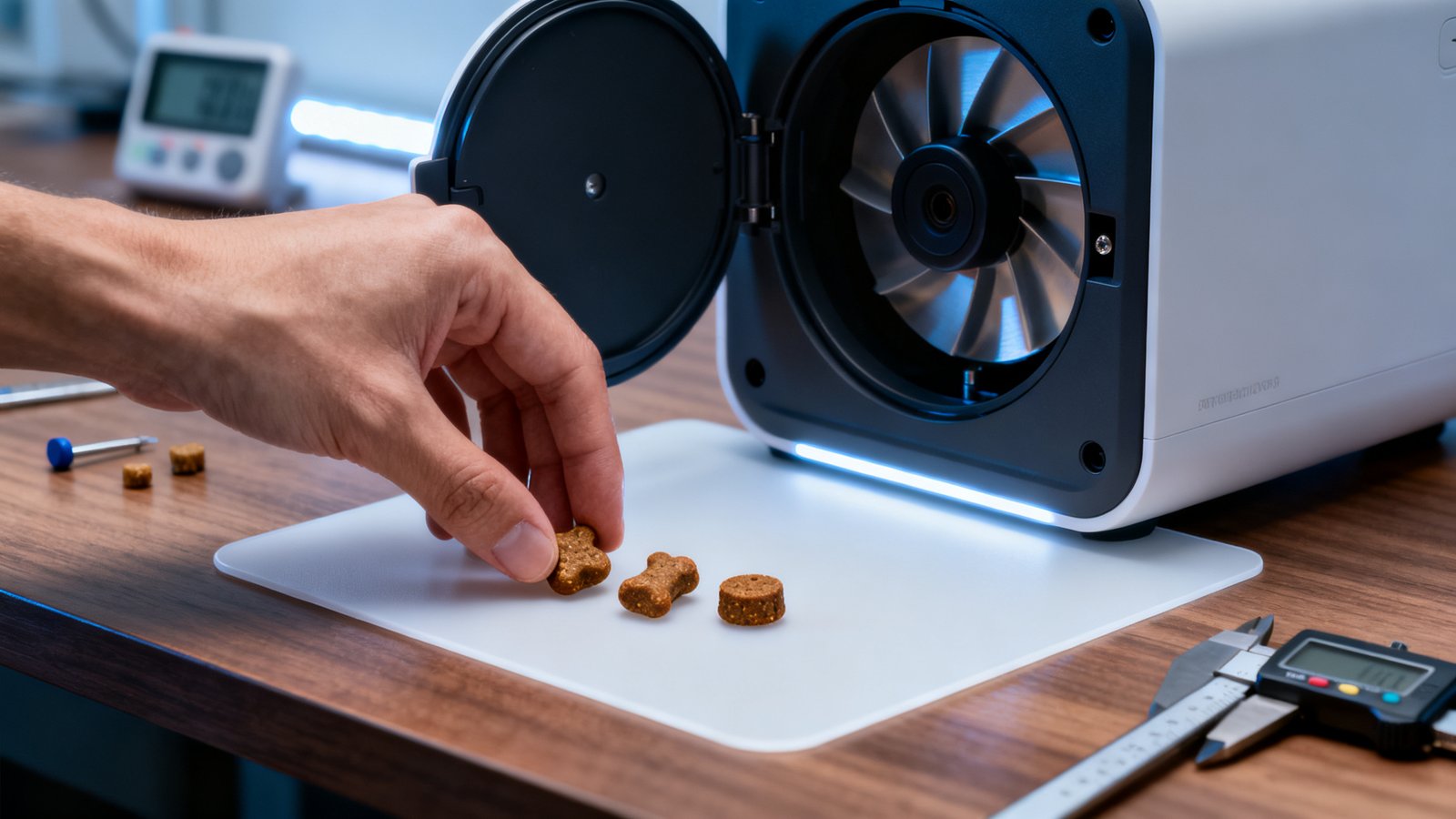
Hopper capacity varies dramatically. Furbo holds roughly 100 treats. Petcube Bites 2 holds about 680 g (1.5 lbs). WOPET’s 6–7L hopper holds several hundred small treats—bordering on automatic feeder territory. More capacity means fewer refills but also more potential for stale treats and crumb buildup. If you treat-toss 3–5 times daily, Furbo’s 100-treat capacity lasts 3–4 weeks. If you’re a heavy user or have multiple pets, Petcube or WOPET makes more sense.
Ejection consistency also degrades as the hopper empties. Light, small treats near the bottom can drop straight down instead of tossing. Some users report treat scatter so unpredictable that pieces land behind furniture. No brand has solved this completely—it’s a physics problem with varying treat mass and hopper fill level.
Daytime vs Night Vision for Indoor Monitoring — Measurable Differences
Most pet monitoring camera indoor listings say “1080p HD with night vision” and move on. That tells you nothing about what you’ll actually see. IR night vision effective range varies from roughly 5 m to 9 m depending on the model. Petcube claims up to 9 m on earlier Bites 2 specs. Furbo and WOPET user reports cluster around 5–8 m. If your pet sleeps 7 m from the camera in a dark room, those 2–3 m of IR range difference determine whether you see a dog or a dark blob.
Dynamic range is a bigger problem than raw distance. Cameras placed near windows struggle with backlight during daytime—your pet becomes a silhouette against bright sunlight. At night, IR LEDs reflect off glossy surfaces (hardwood floors, windows, metal crates), creating glare that washes out the image. No amount of resolution fixes poor dynamic range handling. You’ll only discover this by testing in your specific room layout.
Coat color matters for IR night vision too. White or light-colored pets reflect more IR, appearing brighter and sometimes overexposed. Black or dark-coated pets absorb IR, making them harder to distinguish from dark furniture or shadows. This is rarely tested in reviews but matters enormously for multi-pet households with varied coat colors. For a deeper perspective on tracking pet movement when cameras fall short, our best GPS tracker for dogs 2026 guide covers location monitoring that works regardless of lighting.
Multi-Pet Detection and Alert Accuracy — Why It Matters
Vendors market “pet detection” as a feature. What they rarely clarify is that most systems detect generic motion or a single “pet-shaped” object—not individual animals. If you have two dogs or a dog and a cat, don’t expect the camera to tell you which one is in frame, let alone which one is barking or getting into something.
False positives are common. Curtains moving, TV flickering, shadows from passing cars—all can trigger “pet detected” alerts. False negatives are worse: a pet moving quickly at the frame edge, two pets overlapping, or a small pet partially hidden by furniture often goes undetected. Multi-pet identification accuracy is largely untested in top review lists. Vendors provide no metrics on how well their AI distinguishes multiple animals.
For multi-pet homes, the most reliable approach is combining a wide-FOV camera (like Petcube Bites 2 at 160° or eufy D605 at 170°) with manual check-ins rather than relying on automated alerts. If you need to track which pet is where across a larger property, our Fi vs Halo collar comparison covers GPS-based approaches that complement indoor camera monitoring. Similarly, our Halo Collar 3 review details virtual fence technology that works where cameras can’t reach.
Connectivity, App Reliability, and Latency — Real User Pain Points
Wi-Fi drops are the single most cited complaint across all major treat-dispensing cameras. Furbo, Petcube, and WOPET all generate 1–3 star reviews mentioning “offline” status even when other devices in the home stay connected. Most models use 2.4 GHz Wi-Fi only. Petcube Bites 2 adds 5 GHz support, which helps in congested environments. If your router forces band steering or uses WPA3, expect setup friction—user forums are filled with pairing workarounds.
Typical live view latency runs 1–3 seconds under good conditions. On slower upstream connections or congested networks, 5+ seconds is common. That delay matters when you’re trying to interrupt a behavior in real time. Your “stop that” arrives after the moment has passed. As we documented in our Fi smart collar review, connectivity reliability is the hidden cost of cloud-dependent pet tech—the same pattern applies here.
Cloud dependency is another under-discussed risk. Most treat cameras route live video through vendor servers. If Furbo or Petcube’s cloud has an outage, your local camera becomes a paperweight—no local fallback, no direct LAN streaming. Firmware updates occasionally brick devices or force re-pairing. Before buying, search the camera model plus “firmware update failed” to gauge how common this is.
Side-by-Side Technical Snapshot — Five Leading 2026 Models
Here’s what the specs actually tell you—and what they don’t. All five models below shoot 1080p. Resolution differences are negligible at indoor monitoring distances. What separates them is FOV, pan capability, treat capacity, and frame rate.
| Model | Resolution | FOV | Pan/Tilt | Treat Capacity | Frame Rate | Wi-Fi |
|---|---|---|---|---|---|---|
| Furbo 360° | 1080p | 360° pan, ~90–100° vertical | Yes, motorized 360° | ~100 treats, 10–12 mm | Up to 30 fps | 2.4 GHz only |
| Petcube Bites 2 | 1080p | 160° fixed | None | 680 g, 10–15 mm | Up to 30 fps | 2.4 + 5 GHz |
| WOPET 6L/7L | 1080p | 165° fixed | None | 6–7L, 5–15 mm | Up to 30 fps | 2.4 GHz only |
| eufy D605 | 1080p | 170° fixed | None (software tracking) | 1.5L, 5–15 mm | Up to 15 fps | 2.4 GHz only |
| Petcube Bites 2 Lite | 1080p | 160° fixed | None | Smaller hopper, 10–15 mm | Up to 30 fps | 2.4 GHz only |
Key takeaway: frame rate on eufy D605 tops out at 15 fps—noticeably choppier than the 30 fps competition. The 170° FOV is widest in class but comes with barrel distortion at the edges. Furbo’s 360° pan is the only solution for monitoring pets that move between rooms, but it’s a motorized part that can fail. Petcube’s 5 GHz support is a real advantage in apartments or dense Wi-Fi environments.
Ratings and Price Comparison — What You Pay vs What Users Rate
Treat-dispensing cameras cluster between 4.1 and 4.6 out of 5 stars on major platforms. Non-dispenser smart pet cameras consistently rate higher—4.4 to 4.8—despite costing 3–6× less. The rating gap isn’t about video quality. It’s about mechanical complexity. Every moving part in a treat dispenser is a potential failure point that a static security camera doesn’t have.
Price breakdown: Furbo 360° at USD 199–229, Petcube Bites 2 at USD 199–249 (Lite at USD 129–149), eufy D605 around USD 189–199, WOPET at USD 100–160. Non-dispenser alternatives like Wyze Cam Pan or eufy Indoor Cam run USD 25–70. The premium you pay for treat tossing is roughly USD 100–180 over equivalent video hardware. Whether that’s worth it depends entirely on whether you’ll actually use the dispenser daily. If treat tossing is a novelty that wears off in two weeks, you’ve overpaid for a fixed wide-angle camera with a subscription paywall. Our Tractive GPS review shows a similar pattern in the tracking space—features that sound essential on paper often go unused after the first month.
Power and Battery Realities — Can You Run One on Battery?
No. Treat-dispensing pet cameras require continuous AC power. Period. Furbo, Petcube, WOPET, and eufy all ship with wall adapters and no internal battery beyond maybe a few seconds of backup for clock settings. Real-world power draw runs 5–10 W during normal operation—roughly 40–80 Wh over an 8-hour workday. Your annual electricity cost is well under USD 5.
For power outages, a small 150–300 Wh UPS keeps a camera streaming for 6–12 hours. Users on Reddit and product forums confirm this works for all major models. Battery-powered Wi-Fi cameras exist (Arlo, Blink, EufyCam) but none include a treat dispenser, and continuous live view drains their batteries in 1–2 days. If off-grid operation matters to you, you’re choosing between treat dispensing or battery power—you can’t have both in 2026.
Some WOPET models include a battery backup for scheduled feeding only—not for video or live streaming. Read the fine print. “Battery backup” on a listing often means the clock survives a brief outage, not that the camera stays functional.
Security & Privacy — What to Check Before You Buy
Pet cameras share the same vulnerability classes as consumer IoT security cameras: weak authentication, insecure cloud APIs, unencrypted local streams, and outdated firmware components. The difference between brands is how they’ve responded.
Furbo rolled out two-factor authentication (2FA) by 2024–2025 and uses TLS/SSL encryption for data transmission. Petcube advertises end-to-end encryption for live streams and cloud recordings on AWS infrastructure, with optional 2FA. eufy made public commitments to improved encryption and transparency after scrutiny of their home security camera line. These three brands have at least acknowledged the problem and shipped mitigations.
Budget and white-label brands are a different story. Many lack 2FA entirely, use generic OEM firmware with slow or nonexistent patching cycles, and may expose unsecured RTSP streams. Before buying any pet camera with treat dispenser, check two things: Does the app support 2FA? When was the last firmware update? If you can’t find a firmware changelog dated within the last six months, assume the device is effectively abandoned. For a broader framework on evaluating pet tech purchases, our guide on how to choose GPS tracker dog covers security vetting principles that apply equally to cameras.
How to Test a Treat-Dispensing Pet Camera (Home/Review Lab Protocol)
If you want to validate a camera yourself—or understand what a thorough review should include—here’s the protocol. This is what most “best of” lists skip.
100-dispense jam test: Run 100 dispenses across three treat sizes (8 mm, 10 mm, 12 mm) and two textures (hard crunchy, semi-moist). Record every jam, misfire, or weak drop. Calculate jam rate per 100. Anything above 3% is noticeable in daily use. Anything above 10% is unacceptable.
Latency measurement: Set up a livestream on two devices simultaneously. Point the camera at a running stopwatch or metronome app. Compare the displayed time on each device to real time. Measure on both 10 Mbps and 50 Mbps upstream connections. Record the delta.
Night-vision recognition: Place a pet-sized object (or actual pet) at 3 m, 5 m, and 8 m in complete darkness. Have a second person verify via the app whether the object is recognizable as an animal. Repeat with light and dark surfaces to test IR reflectivity bias.
Multi-pet detection: With two pets (or a pet and a human decoy), run scenarios: pets crossing paths, one pet partially occluded by furniture, pets at opposite edges of the frame, and both stationary. Record false positives and missed detections over a 30-minute window.
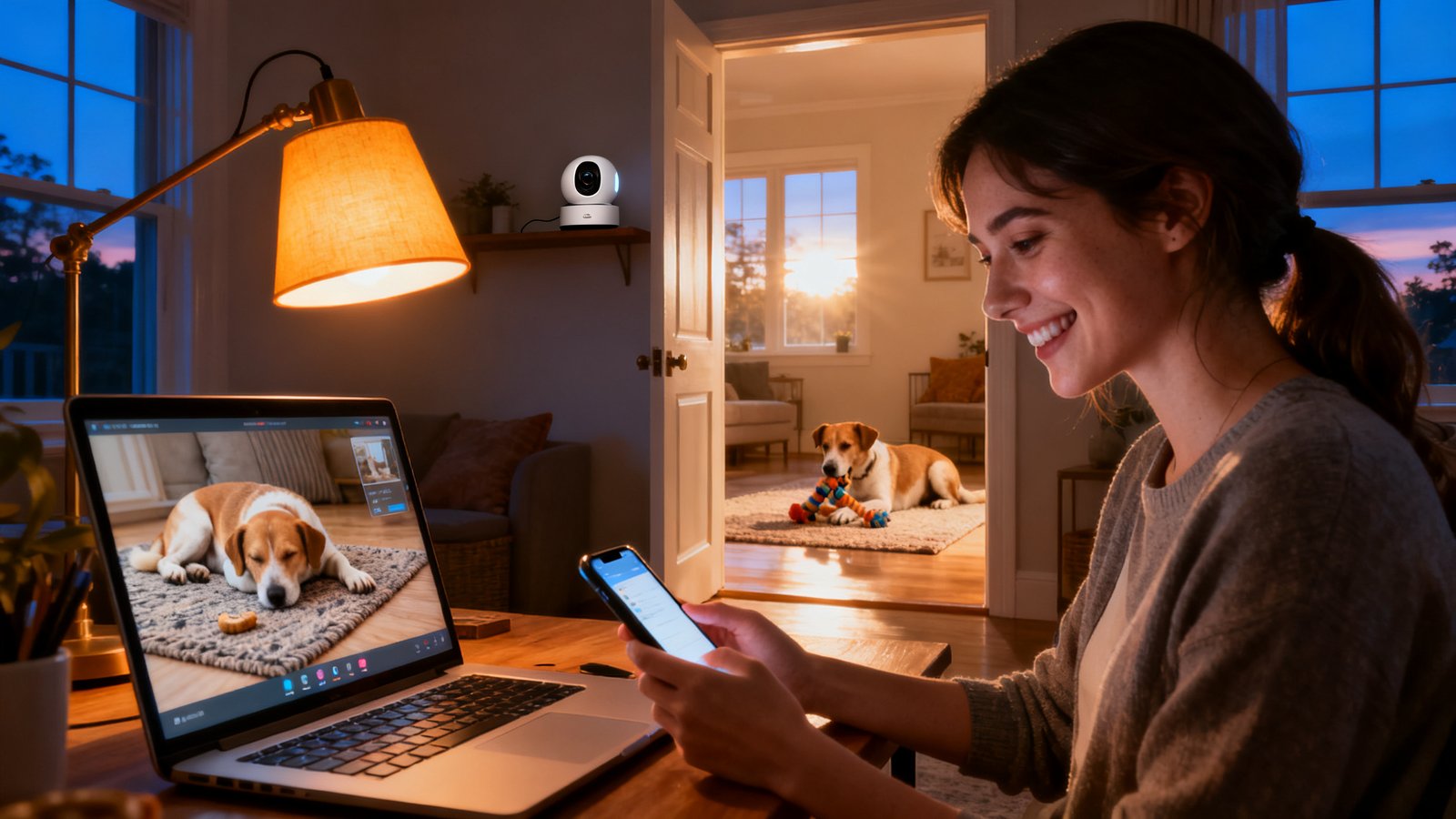
Final Buying Checklist — Make the Decision Fast
Run through these eight checks before you click buy. Each one eliminates common sources of buyer’s remorse.
- Treat size compatibility: Measure your preferred treats with a ruler. If they’re not within the manufacturer’s stated range, pick a different camera or different treats. No workaround exists for physical incompatibility.
- Hopper capacity vs usage: If you toss treats 5+ times daily or have multiple pets, a larger hopper (Petcube 680 g or WOPET 6–7L) saves constant refilling. Light users can manage with Furbo’s 100-treat capacity.
- AC power requirement: Confirm you have an outlet within cable reach of the camera’s intended location. No battery-powered treat dispenser exists. Budget for a small UPS if outages are common in your area.
- FOV and pan needs: Fixed wide-angle (160–170°) covers one room well. Motorized pan (Furbo 360°) covers multiple rooms but adds a failure point. Choose based on your pet’s roaming range.
- Night-vision distance: Measure from your planned camera position to where your pet sleeps. If it’s beyond 7 m, verify the model’s IR range spec. User reports are more reliable than marketing claims here.
- Multi-pet detection: If you have multiple animals, assume generic “pet detection” won’t distinguish them. Use manual check-ins as your primary monitoring method.
- Subscription reality: Check which features are paywalled. Barking alerts, cloud recording, and smart detection often require monthly fees. Add USD 50–100/year to your total cost if you need these.
- Security and firmware: Verify 2FA availability and check the app store for recent update dates. A camera last updated in 2023 is a security liability.
Conclusion
The best pet camera 2026 for your home depends on three things most reviews won’t ask: what size treats you actually use, how far your pet sleeps from the camera at night, and whether you’re willing to pay a subscription to unlock features already built into the hardware. Furbo 360° earns the top recommendation for treat-dispensing reliability and room coverage, but its 2.4 GHz-only Wi-Fi and smaller treat size tolerance won’t work for everyone. Petcube Bites 2 offers a wider treat range and 5 GHz support at a similar price, with the tradeoff of a fixed lens. Budget buyers should look hard at WOPET but budget for potential app frustrations. And if treat dispensing isn’t a daily necessity, save USD 100–170 and buy a quality pan/tilt security camera—your wallet and your pet won’t notice the difference. Whichever model you choose, test it ruthlessly in the first week. Jam rate, night clarity, and latency only reveal themselves through use, not spec sheets.
Frequently Asked Questions
What is the best pet camera with treat dispenser in 2026?
Furbo 360° Dog Camera leads the category for overall reliability, treat-dispensing consistency, and multi-pet room coverage via its motorized 360° pan base. It holds roughly 100 treats at the recommended 10–12 mm size and maintains a 4.5–4.7 rating across over 30,000 Amazon reviews. Petcube Bites 2 is the strongest alternative if you need 5 GHz Wi-Fi support or a wider treat size range (10–15 mm).
Can I use a pet camera without a subscription in 2026?
Partially. Live video viewing and manual treat tossing work without a subscription on Furbo, Petcube, and most other models. Advanced features—barking alerts, pet detection notifications, cloud recording, and activity history—typically require a monthly or annual plan. Expect to pay USD 50–100 per year for full functionality on premium brands. Non-dispenser cameras like Wyze or eufy Indoor Cam offer more features without a subscription at a much lower hardware cost.
How often do treat dispensers jam, and can I prevent it?
Treat jams are the most common hardware complaint across all brands. No manufacturer publishes official jam rates, but user reviews indicate jams become frequent when treats exceed the recommended diameter or when crumbly/semi-moist treats leave residue inside the mechanism. Stick to the manufacturer’s size specs exactly (10–12 mm for Furbo, 10–15 mm for Petcube), use hard crunchy treats, and clean the dispenser mechanism monthly to minimize jams. Running plain kibble through periodically helps clear residue.
Do pet cameras work well at night for monitoring multiple pets?
Night vision performance varies significantly by model and room conditions. Effective IR range spans roughly 5–9 m depending on the camera—Petcube claims up to 9 m, while Furbo and WOPET users report 5–8 m of usable range. Glare from windows and glossy surfaces degrades image quality regardless of brand. Dark-coated pets are harder to distinguish at night because they absorb IR light. Most cameras cannot distinguish individual pets in darkness—you’ll see shapes and movement, not identities.
Are pet cameras with Wi-Fi secure from hacking?
Reputable brands (Furbo, Petcube, eufy) have implemented TLS/SSL encryption, optional two-factor authentication, and regular firmware updates that address known vulnerabilities. Budget and white-label brands often lack 2FA entirely and may use insecure P2P protocols. Before buying, check whether the app supports 2FA and verify the date of the most recent firmware update. A camera without a firmware changelog from the past six months should be considered a security risk. Use a strong unique password and enable 2FA on any indoor camera.